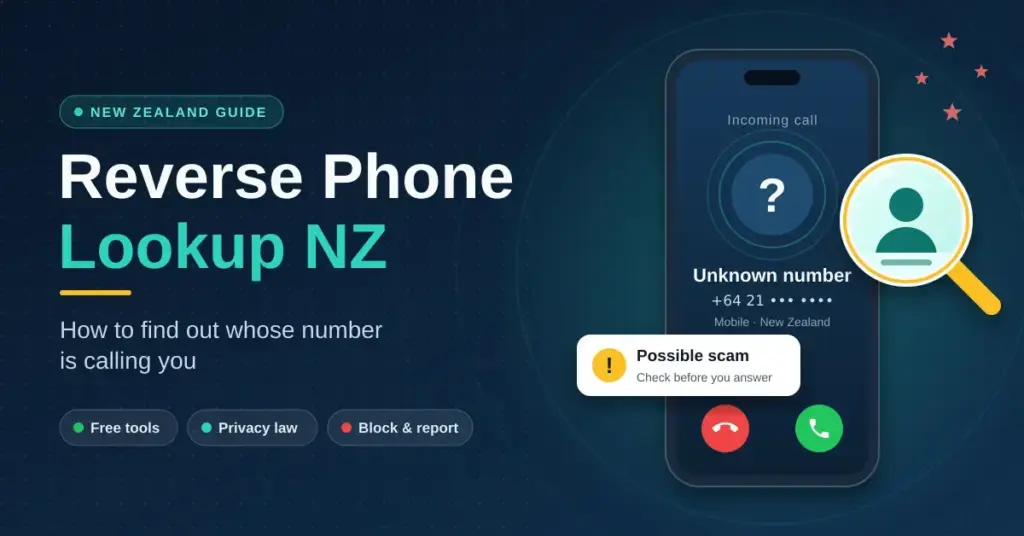
Working out whose phone number is calling you is a small but important part of staying safe online in New Zealand. Whether the caller is a persistent telemarketer, a possible scammer, or simply a number you do not recognise, a few practical tools can help you put a name to a number and decide whether to answer, block or report it. This guide explains how reverse phone lookup actually works in Aotearoa, which free and paid methods are worth trying, what New Zealand privacy law does and does not allow, and how phone location tracking really functions — without the myths. It is written for everyday users, so every technical term is explained the first time it appears.
Key Points
- Reverse lookup basics: You search by number to find a name — easy for listed landlines and businesses, hard for private mobiles.
- Free first: A Google search, a community spam site like tellows, or a caller-ID app usually identifies spam without paying.
- The law: Mobile subscriber data is private under the Privacy Act 2020; only the Police can request it in an investigation.
- 018 works one way: It gives a number from a name and area, but never a name from a number.
- Scams are rising: New Zealand scam losses hit a record ~NZ$3 billion in 2025; caller ID is easy to spoof, so stay sceptical.
- Protect yourself: Go unlisted, block caller ID, limit app permissions, and keep a spare number for sign-ups.
What Reverse Phone Lookup Means in New Zealand
A reverse phone lookup is the opposite of a normal phone-book search: instead of starting with a name and finding a number, you start with a number and try to find the name or business behind it. In New Zealand this is done through a mix of free web searches, official directories and community-driven mobile apps. When you type a number into a lookup tool, it checks that number against whatever data the service can legally access — public business listings, directory entries, and, in the case of crowdsourced apps, labels that other users have added.
It is important to be realistic about the results. Landline and business numbers that are publicly listed are usually easy to identify. Private mobile numbers are a different story: subscriber names and addresses for mobiles are not published anywhere public in New Zealand, so any name you see for a mobile almost always comes from how that number is saved in other people’s contacts, not from an official record.
- Public directories: Listed residential landlines and business numbers appear in the White Pages and similar directories.
- Crowdsourced databases: Apps such as Truecaller draw on a global community — now more than 500 million monthly users — who tag and report spam and nuisance numbers.
- Search engines and social media: A quick Google search, or a look on Facebook or Instagram, sometimes links a number to a public profile or a business page.
- Carrier metadata: The first digits of a number and its prefix can tell you which New Zealand provider (Spark, One NZ or 2degrees) the number is routed through, and whether it is mobile or landline.
Why Real-Time Caller ID Matters
Real-time caller ID has become a front-line defence against “spoofed” numbers — calls where the number on your screen has been faked to look local or trusted. By plugging a live spam database into your phone’s dialler, apps like Truecaller can flag a call as a likely scam before you answer. That matters for households and small businesses alike: a genuine missed call can cost a sale, but answering the wrong call can cost far more. The convenience of the modern smartphone is exactly why callers try to exploit it, so a warning label at the moment the phone rings is genuinely useful.
Free Ways to Identify an Unknown Number
Before paying for anything, most New Zealanders can identify a caller using tools they already have. The cost of a “background report” website is rarely justified for a single nuisance call, and many of those overseas sites hold little accurate New Zealand data anyway.
- Search the number online: Paste the full number (with and without the +64 country code) into Google. Scam and marketing numbers are often discussed on forums or complaint sites.
- Check a community spam site: New Zealand-focused services such as tellows list user reports and a risk score for a given number.
- Use a caller-ID app: Truecaller, Sync.me and Hiya identify many spam numbers automatically and let you block them.
- Look it up in the White Pages: For listed landlines and businesses, the official directory remains the most reliable free option.
You may have read that entering a mobile number into a payment app can reveal the owner’s name from their linked bank account. This sometimes works, but it is unreliable, depends on the person having registered that exact number, and raises obvious privacy questions — so treat it as a last resort rather than a dependable method.
Comparing Caller-ID and Lookup Tools
Which tool fits depends on whether you want an instant spam warning or a deeper search of public records. Mobile-first apps are best for real-time blocking, while directories and community sites are better for checking a specific number after the fact. The table below sets out the main options available to New Zealand users, with links to each official source.
Comparison of Lookup Tools
| Tool | Type | Best for | Cost |
|---|---|---|---|
| Truecaller | Caller-ID app (Android/iOS) | Community spam ID and blocking | Free; optional Premium |
| Sync.me | Caller-ID app | Caller ID and reverse search | Free; optional Premium |
| Hiya | Caller-ID app | Spam protection and call screening | Free; optional Premium |
| tellows NZ | Community website | Risk scores and user reports for a number | Free |
| White Pages (Yellow NZ) | Official directory | Listed landlines and businesses | Free |
| Google Search | Web search | Public mentions and complaints about a number | Free |
The Value of Community-Powered Detection
Community reporting is what separates modern caller-ID apps from traditional directories. When one user marks a number as “scam” or “telemarketer”, that label is shared across the network, so millions of other people are warned about the same number within minutes. Because scammers change numbers constantly, this collective approach often reacts faster than any single official database could. The trade-off is privacy: these networks are built partly from the contact lists of their own users, which is one reason to think carefully about which apps you grant access to your contacts.
Is Reverse Phone Lookup Legal in New Zealand?
Using publicly available information — a listed business number, a Google result, a name someone has chosen to publish — is perfectly legal. What is not available is the private subscriber data behind a mobile number. Under the Privacy Act 2020, telecommunications providers hold that information securely and do not release it for public reverse-lookup searches. This is why “reverse lookup” sites cannot legitimately hand you the registered owner of any New Zealand mobile.
If a number is behind something serious — harassment, threats or fraud — identifying the owner is a job for the authorities, not a lookup app. The New Zealand Police can lawfully request subscriber details from a carrier as part of a formal investigation. For guidance on your information rights, the Office of the Privacy Commissioner explains how personal data must be collected, used and disclosed.
- Mobile data is private: Names and addresses tied to mobile numbers are not public information.
- Police can request records: Carriers may disclose subscriber details to Police under a formal, lawful request.
- Caller ID can be faked: The number on your screen is easy to spoof, so it may not be the real origin of a call.
- Aggregated location data has limits: Anonymised movement data is sometimes used for planning and analytics, and privacy advocates continue to debate how well “anonymised” it really stays.
Reporting Harassing and Nuisance Calls
Harassing or threatening calls are treated seriously in New Zealand. Misusing a telephone to menace or harass someone is an offence under the Telecommunications Act 2001, and online harassment can be reported to Netsafe, the approved agency under the Harmful Digital Communications Act 2015. Practical first steps are to document the dates and times of the calls, block the number on your device, and contact your carrier’s nuisance-call team. For threats to your safety, call 111; for non-urgent matters, Police can be reached on 105.
The 018 Directory Service and the White Pages
If you prefer a non-digital route, New Zealand still offers 018 National Directory Assistance. By calling 018 you can ask an operator for the phone number and address of a listed person or business. Crucially, 018 works in one direction only: for privacy reasons the operator cannot tell you a name or address from a phone number — you must supply a name and rough location to receive a number. Calls are charged per use.
| Feature | 018 Directory Assistance | Online / app lookup |
|---|---|---|
| Search direction | Name + area → number | Number, name or email |
| Name from a number? | No — blocked for privacy | Only via community tags, not official records |
| Best coverage | Listed landlines and businesses | Mobiles flagged by the community |
| Typical cost | Roughly $0.64–$1.03 per call | Free to paid subscriptions |
Unlisted and Confidential Numbers
Many New Zealanders choose an “unlisted” or “confidential” listing, which keeps their details out of the White Pages and away from 018. That creates a genuine dead end for traditional search methods. In those cases, crowdsourced apps are sometimes the only tool that returns anything, because they rely on how a number is stored in other people’s phones rather than on any official directory — and even then, the result may be incomplete or wrong.
How Phone Location Tracking Actually Works
“Tracking” a phone — working out where a device is — relies on several layers of technology, each with very different accuracy. Carriers can approximate a location from the cell towers a phone connects to, while apps you have granted permission to (maps, ride-share, safety apps) use the Global Positioning System (GPS), a network of satellites that pinpoints a device far more precisely.
| Method | Typical accuracy | Where it is used |
|---|---|---|
| GPS | Around 5 metres in the open | Maps, navigation and personal-safety apps |
| Cell-tower location | Hundreds of metres to several kilometres | Call routing and broad emergency location |
| Wi-Fi positioning | Roughly 10–50 metres | Indoor and dense urban areas |
| Geofencing | A defined virtual boundary | Site sign-in, delivery and safety apps |
Geofencing at Work Sites
Geofencing draws a virtual boundary around a real-world area. In New Zealand’s construction and industrial sectors, safety apps use it to sign workers in and out automatically as they enter or leave a site, so a site manager knows exactly who is present in an emergency. Importantly, this only works with the worker’s phone and consent — it is not a way to secretly track a stranger.
Protecting Your Own Number From Reverse Lookup
If you would rather not be found, you can reduce how easily your number is linked back to you. The simplest step is to ask your provider to make your listing “unlisted” or “confidential”, which removes your details from the White Pages and 018. Beyond that, good digital hygiene keeps your number from being tied to your wider identity online.
- Go unlisted: Ask your carrier to remove your number from public directories and directory assistance.
- Hide your caller ID: Your provider can present outbound calls as “Private” or “Unknown”.
- Guard your domain details: If you own a website, use domain privacy so your phone number stays out of public WHOIS records.
- Limit app permissions: Be cautious about apps that ask for your contacts; a good password manager and tidy account hygiene reduce how much of your identity is exposed if one service is breached.
- Use opt-outs: Some lookup sites let you request removal of your profile from their database.
Managing Your Digital Footprint
Your mobile number is often the anchor that ties your online accounts together. If you use the same number for social media, marketplace listings and forums, a simple search can connect it to your full name and photos. For higher privacy, keep a secondary number for online sign-ups, review the privacy settings on your accounts, and consider using a VPN — a tool that encrypts your internet traffic — when you are on public Wi-Fi. Strong all-round cyber security in New Zealand habits make it far harder for anyone to build a profile from a single number. If your details are ever exposed, understanding what counts as a privacy breach helps you respond quickly.
Identifying Business Callers and Call Tracking
For businesses, knowing whose call is coming in is about marketing as much as security. Call-tracking software shows which advertisement, web page or keyword prompted someone to phone. Using dynamic number insertion (DNI) — a technique that swaps the phone number shown on a website depending on how the visitor arrived — a company can measure which campaigns actually generate calls.
- Marketing attribution: See whether a call came from a Google ad, an organic search result or a printed flyer.
- Quality and training: Recorded calls (with proper disclosure) help teams improve service.
- Dynamic number insertion: Assigns tracking numbers automatically based on the visitor’s source.
- CRM integration: Pushes call and lead details straight into sales software for follow-up.
An 0800 number also helps a business look established and trustworthy, because the call is free to the caller and the number is formally registered — making it easier for customers to be confident about who they are ringing.
Scams, Spoofing and the Future of Caller Identity
Scam calls remain a serious problem. Netsafe’s State of Scams report put total scam losses in New Zealand at a record figure of around NZ$3 billion in 2025, up sharply on the previous year. New Zealand does not use the STIR/SHAKEN caller-authentication system rolled out in North America; instead, the local industry works to a Scam Prevention Code coordinated by the New Zealand Telecommunications Forum (TCF), under which providers including Spark, One NZ and 2degrees share information and block numbers confirmed to be used by scammers.
| Approach | What it does | Status in New Zealand |
|---|---|---|
| Caller-ID apps | Flag and block known spam numbers in real time | Available now (Truecaller, Sync.me, Hiya) |
| On-device call screening | Answers or screens unknown calls before you pick up | Built into many modern phones |
| TCF Scam Prevention Code | Industry sharing and blocking of scam numbers and texts | In force; expanded to cover scam SMS |
| STIR/SHAKEN | Cryptographically verifies caller ID between networks | Used overseas, not deployed in NZ |
AI-assisted screening is improving quickly, and some apps can now interact with an unknown caller before you answer. But no technology replaces basic caution: if you do not recognise a caller and they pressure you for money, passwords or personal details, it is almost certainly a scam. Hang up and, if in doubt, call the organisation back on a number you have verified independently.
Disclaimer
This article is general information about identifying phone numbers and protecting your privacy in New Zealand. It is not legal advice, and it does not endorse tracking or identifying any individual without their consent. Reverse-lookup results — especially for mobiles — can be inaccurate. For serious harassment, threats or fraud, contact the New Zealand Police (105 for non-emergencies, 111 in an emergency). For privacy questions contact the Office of the Privacy Commissioner, and for scam or harassment support contact Netsafe.
Reference sources
Frequently Asked Questions (FAQ)
How can I find out whose number is calling me in New Zealand?
Start with the free options: search the full number on Google, check a community spam site such as tellows, or install a caller-ID app like Truecaller. For listed landlines and businesses, the White Pages is the most reliable source. Private mobile numbers are harder, because subscriber details are not public.
Is reverse phone lookup legal in New Zealand?
Using publicly available information is legal. However, the private subscriber data behind a mobile number is protected under the Privacy Act 2020 and is not released for public reverse-lookup searches, so no legitimate service can simply hand you the registered owner of a New Zealand mobile.
Can I find a name from a mobile number for free?
Sometimes, but not reliably. Free searches, social media and crowdsourced apps may show a name if the number is tied to a public profile or has been labelled by other users. Many mobiles return nothing, because their details are private and unlisted.
What should I do about harassing or scam calls?
Record the dates and times, block the number on your phone, and report it to your carrier’s nuisance-call team. Harassment can be reported to Netsafe, and threats to your safety to the Police on 111 (or 105 for non-urgent matters). Never share personal or banking details with an unexpected caller.
How do I keep my own number out of reverse-lookup results?
Ask your provider to make your listing unlisted or confidential, which removes you from the White Pages and 018. Enable caller-ID blocking for outbound calls, use domain privacy if you own a website, and keep a separate number for online sign-ups to limit how easily your main number is linked to you.