
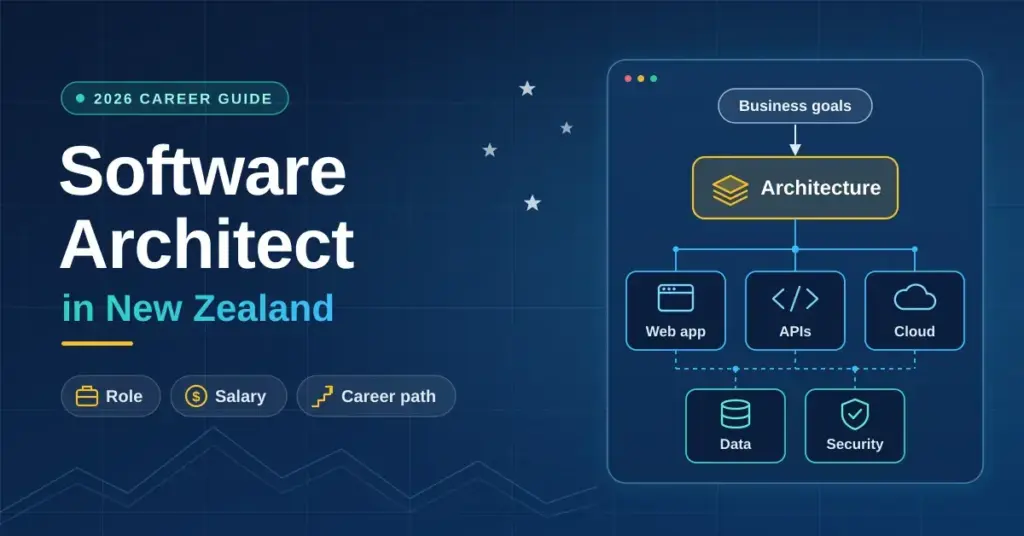
A software architect sits at the top of the technical ladder, turning business goals into a workable blueprint for the systems that run a company. In New Zealand’s fast-growing digital sector, the role has become one of the most sought-after and best-paid technical positions, blending deep engineering knowledge with leadership and communication. This guide explains what the job actually involves, the realistic pay you can expect in 2026, the study and certification pathways that lead into it, and how the role differs from the closely related solutions and enterprise architect titles. Wherever numbers appear, they are drawn from current New Zealand salary aggregators and official sources rather than guesswork.
Key Facts
- Role: High-level technical design lead who turns business needs into system blueprints
- Typical NZ salary (2026): ~NZ$120,000–$180,000; senior/specialist roles NZ$180,000–$200,000+
- Usual entry point: 7–10 years’ experience, often from a senior or principal developer role
- Common study path: BEng (Hons) or BSc in software engineering, computer science, or information sciences
- Key certifications: AWS or Azure Solutions Architect, TOGAF, iSAQB CPSA
- Green List: No “software architect” occupation; related roles such as Software Engineer (261313) are on Tier 1
- Main hubs: Auckland and Wellington, with hybrid and remote work now common
What a Software Architect Actually Does
A software architect is not simply a very senior developer. They are responsible for the high-level design of a system — the structure that everything else is built on. Where a developer decides how to write a particular feature, an architect decides how the whole system is shaped: how services talk to each other, where data lives, how the design will cope with growth, and how it stays secure and maintainable over years rather than sprints. In short, an architect translates the “what” of a business need into the “how” of a technical plan.
Across New Zealand, many organisations are moving away from large, single-block “monolithic” applications (one big program that does everything) toward modular services that can be updated independently. That shift has put architects at the centre of a lot of transformation work. Their core duties usually include:
- System design: Defining service boundaries, data flows, and how components interact, so the pieces fit together predictably.
- Setting standards: Establishing coding conventions, patterns, and review practices that keep multiple teams consistent.
- Managing risk: Spotting technical and security risks early — especially in regulated sectors such as banking, government, and healthcare — and planning around them.
- Stakeholder communication: Explaining trade-offs in plain language to product managers, executives, and clients who are not engineers.
- Mentoring: Coaching developers and lifting the overall design maturity of the teams they support.
A Typical Week in the Role
The job is a mix of quiet, focused design work and a lot of collaboration. An architect rarely spends the whole day coding; instead they move between diagramming, reviewing others’ work, and steering decisions. The table below outlines the main areas of responsibility and why each one matters to a New Zealand business.
| Task area | What it involves | Why it matters |
|---|---|---|
| System blueprinting | Producing technical designs and diagrams that describe how a system is put together | Ensures components integrate cleanly instead of being bolted on later |
| Security and scalability planning | Designing for growth and building in security from the start | Protects data and keeps the system usable as demand rises |
| Mentorship and review | Guiding developers and reviewing key technical choices | Raises code quality and speeds up delivery across teams |
| Modernisation | Breaking legacy monoliths into well-defined, independent services | Cuts long-term maintenance cost and technical debt |
Software Architect vs Solutions Architect vs Enterprise Architect
These three titles are often used loosely, and pay data blurs them together, but they describe different scopes of work. Understanding the distinction helps when reading job ads or planning a career move.
- Software architect: Focuses on the internal structure of an application or product — its code, components, and technical patterns. The lens is a single system done well.
- Solutions architect: Focuses on how technology solves a specific business problem, often stitching together several systems, vendors, and integrations to deliver an outcome.
- Enterprise architect: Works at the organisation-wide level, aligning the entire technology landscape with long-term business strategy and governance. This is where frameworks like TOGAF are most relevant.
In practice, many roles overlap, and a person may carry different titles at different employers for similar work. Cloud architects and security architects are common specialisations that layer on top of these categories, and demand for both is strong in New Zealand.
How Much Software Architects Earn in New Zealand (2026)
Salary data for this role varies widely between sources, because job titles and seniority are reported inconsistently and much of the data is self-reported. Aggregators such as Seek, Indeed, and Glassdoor put typical software architect pay in New Zealand somewhere between roughly NZ$120,000 and NZ$180,000 a year in 2026, with many estimates clustering around NZ$150,000–$170,000. Senior, enterprise, and specialist architects — particularly in cloud and security — can move beyond NZ$180,000, and the most in-demand leads in Auckland and Wellington report packages approaching or exceeding NZ$200,000.
Contract roles are usually quoted at a higher effective rate than salaried positions to offset the lack of paid leave and benefits, although advertised day rates rise and fall with demand. Because published figures differ so much, treat any single number with caution and cross-check several sources for your specific specialisation and city. For context, it is worth comparing these figures with typical software developer salaries in New Zealand, which sit a clear step below architect level.
What Drives an Architect’s Pay
- Seniority: Lead and principal architects command the top of the range; those newly moved up from senior developer roles start lower.
- Specialisation: Cloud and cybersecurity architecture tend to pay a premium because the skills are scarce.
- Sector: Banking, fintech, and large enterprise pay more than smaller product companies or the public sector.
- Location: Auckland and Wellington concentrate the best-paid roles, though remote and hybrid work has widened the field.
- Employment type: Contracting can lift effective earnings but removes the security and benefits of a permanent package.
Education and Study Pathways in New Zealand
Most New Zealand employers expect an architect to hold a relevant degree, typically a Bachelor’s or Master’s in software engineering, computer science, or information sciences. Software engineering degrees are distinctive because they pair computer science with formal engineering discipline, covering software architecture, system performance, and requirements analysis. At both the University of Auckland and AUT, the Bachelor of Engineering (Honours) in Software Engineering requires students to complete 800 hours of supervised practical work experience before they can graduate — a genuine head start for industry readiness.
| Institution | Qualification | Key focus areas |
|---|---|---|
| University of Auckland | BEng (Hons), Software Engineering | Software architecture, testing, quality; 800 hours practical work |
| AUT | BEng (Hons), Software Engineering | Data structures, algorithms; 800 hours practical work |
| Massey University | Bachelor of Information Sciences | Systems analysis, modelling, and network design |
| Postgraduate options | Master of Software Engineering | Advanced systems architecture and applied research |
Core Subjects and Skills to Master
Whichever route you take, a few areas of knowledge do the heavy lifting when you move into design work:
- Design patterns and software theory: The reusable solutions and formal principles that keep systems stable.
- Distributed systems: How services, databases, and networks behave when spread across many machines and regions.
- Data modelling: Capturing and structuring information so systems stay fast and consistent as they scale.
- Secure design: Applying the principles of authentication, encryption, and safe client-server communication from the outset.
Professional Certifications Worth Holding
A degree gets you in the door; certifications often set candidates apart in a competitive market. Because so much New Zealand infrastructure now runs on cloud platforms, vendor certifications from Amazon, Microsoft, and Google carry real weight, while framework and vendor-neutral credentials prove broader design ability. The most widely recognised options are compared below, with links to the official programmes so you can check current requirements and costs directly.
Comparison
| Certification | Best for | Focus | Provider (official page) |
|---|---|---|---|
| AWS Certified Solutions Architect | Cloud architects on AWS | Designing scalable, secure AWS systems | Amazon Web Services |
| Azure Solutions Architect Expert | Microsoft-heavy enterprises | Architecting solutions on Microsoft Azure | Microsoft |
| Google Professional Cloud Architect | Google Cloud environments | Designing and managing GCP solutions | Google Cloud |
| TOGAF Standard | Enterprise architects | Business and IT-landscape alignment | The Open Group |
| iSAQB CPSA (Foundation/Advanced) | Software architects | System-level software architecture | iSAQB |
| Certified Kubernetes Administrator (CKA) | Cloud-native platforms | Running and scaling container systems | CNCF / Linux Foundation |
The 2026 Job Market and In-Demand Skills
New Zealand’s technology sector is sizeable: tech exports reached roughly NZ$20 billion in the 2025 financial year, making it one of the country’s largest export earners after dairy and tourism, with Auckland and Wellington generating the bulk of that activity. That scale sustains steady demand for experienced architects, even through quieter hiring cycles. A defining trend for 2026 is the push to make systems “AI-ready” — designing platforms that can integrate machine learning and generative AI safely — alongside continued cloud migration and a strong focus on security. Cloud and cybersecurity architecture, in particular, remain in short supply.
Several sectors do most of the hiring for architectural roles:
- Banking and fintech: Large digital transformations of core platforms and payment systems.
- Global SaaS: High-growth New Zealand software companies building products for international users.
- Health and biotech: Firms working with sensitive data, distributed computing, and machine learning.
- Government and infrastructure: Public-sector modernisation and resilience projects with strict compliance needs.
Security is now a thread that runs through almost every architecture brief; if you are moving into the field, a solid grounding in cybersecurity practice in New Zealand and in cloud computing fundamentals is close to essential.
Moving from Developer to Architect
The path into architecture is usually a gradual one, built over roughly seven to ten years of increasing responsibility rather than a single promotion. A common progression looks like this:
- Software developer: Writing, testing, and debugging code and learning how requirements become features.
- Senior developer: Owning larger components, mentoring juniors, and influencing technical choices.
- Principal or lead engineer: Driving technical direction across a team and connecting strategy to delivery.
- Software architect: Designing the overall system and setting the standards others build to.
If you are earlier in that journey, our guide to building a software engineering career in New Zealand covers the foundational steps in more detail.
Working in New Zealand as an Overseas Architect: Visas and the Green List
New Zealand’s Green List offers faster residence pathways for in-demand occupations, and it is often cited in relation to architecture roles — but the detail matters. As of the 9 March 2026 Green List, there is no standalone “software architect”, “solutions architect”, or “enterprise architect” occupation on the list. What is listed, on Tier 1 (Straight to Residence), are several closely related roles that architects frequently hold:
- Software Engineer (ANZSCO 261313)
- Developer Programmer (261312)
- Analyst Programmer (261311)
- ICT Security Specialist (262112)
Eligibility is tied to your ANZSCO occupation classification and a wage threshold — NZ$72.80 per hour for these software roles at the time of writing — so what counts is how your job is officially classified, not the exact wording of your title. Because immigration settings change, always confirm the current rules with Immigration New Zealand before relying on any pathway. Anyone processing personal or organisational data here should also understand their obligations under the Privacy Act 2020, which shapes a great deal of system design work in New Zealand.
Hard and Soft Skills That Define the Role
Technical depth is a prerequisite, but the step up to architecture is really about judgement and communication. Job advertisements in Auckland and Wellington consistently list decision-making and cross-functional communication among the most desired attributes, alongside the expected engineering credentials. The blend that employers look for includes:
- Hard skills: System design patterns, distributed systems, API design, and cloud scalability.
- Programming depth: Strong command of languages such as Java, C#, or Python, with Go and Rust increasingly valued.
- Business acumen: Understanding budgets, trade-offs, and how technical choices affect cost and revenue.
- Leadership and communication: Guiding teams, resolving disagreements, and explaining complex ideas to non-technical stakeholders.
It is the combination — the ability to design a robust system and to bring people along with the decision — that separates a capable senior engineer from an effective architect.
Sources
- Seek — Software Architect salary in Auckland
- Indeed — Software Architect salary in New Zealand
- Immigration New Zealand — Appendix 13, Green List (09/03/2026)
- AUT — Bachelor of Engineering (Honours), Software Engineering
- University of Auckland — Engineering practical work requirement
- iSAQB — CPSA certification programme
- IT Brief NZ — New Zealand tech exports hit NZD $20bn (2025 TIN Report)
Frequently Asked Questions (FAQ)
How much does a software architect earn in New Zealand?
Estimates vary by source, but 2026 figures generally fall between about NZ$120,000 and NZ$180,000 a year, with senior and specialist architects in cloud or security reaching NZ$180,000–$200,000 or more. Always cross-check several salary aggregators for your city and specialisation.
Do I need a degree to become a software architect?
Most New Zealand employers expect a Bachelor’s or Master’s degree in software engineering, computer science, or information sciences, along with several years of hands-on development experience. Certifications and a strong track record can strengthen a candidate further.
Which certifications are most valuable for architects in New Zealand?
Cloud credentials such as AWS Certified Solutions Architect and Azure Solutions Architect Expert are in high demand, while TOGAF suits enterprise architects and the iSAQB CPSA proves system-level software architecture skill. The right choice depends on your platform and specialisation.
Is software architecture on the New Zealand Green List?
The Green List does not list “software architect” as a distinct occupation. However, closely related roles that architects often hold — such as Software Engineer (ANZSCO 261313), Developer Programmer, and ICT Security Specialist — sit on Tier 1 (Straight to Residence), subject to wage thresholds. Confirm your classification with Immigration New Zealand.
What is the difference between a software architect and a solutions architect?
A software architect focuses on the internal structure and code of a single system, while a solutions architect focuses on how technology solves a wider business problem, often connecting several systems and vendors. Enterprise architects work at the whole-organisation level.