Surfshark and NordVPN are two of the most heavily advertised VPNs in New Zealand, and they are often shortlisted together. They look similar on the surface — both encrypt your connection, both have Auckland servers, both promise to unblock streaming — so the real question is where they differ and which one fits how you actually use the internet. This guide compares them on the points that matter to a New Zealand user: server coverage, speed, privacy, streaming, device limits and price. If you are still deciding whether you need one at all, it helps to first understand what a VPN does for New Zealand users.
Key Points
- Same owner: both Surfshark and NordVPN sit under Nord Security after a 2022 merger, but run as separate products.
- Network: NordVPN is bigger (9,300+ servers, ~137 countries) and has more NZ servers; Surfshark has 4,500+ servers in 100 countries. Both have Auckland locations.
- Devices: Surfshark allows unlimited simultaneous connections; NordVPN caps at 10.
- Jurisdiction: NordVPN is in Panama (outside Five/Nine/14 Eyes); Surfshark is in the Netherlands (Nine Eyes). Both pass independent Deloitte no-logs audits.
- Price: Surfshark is usually the cheaper entry point; NordVPN costs a little more but bundles more extras. Both have a 30-day money-back guarantee.
The one thing most comparisons miss: same owner
Surfshark and NordVPN are not rivals in the usual sense. Since their 2022 merger, both brands sit under the same parent company, Nord Security. They still run as separate products with different apps, networks and pricing, but they share an owner and a general approach to security.
That matters for two reasons. First, choosing between them is less about trusting one company over another and more about features and value. Second, their marketing often compares them as if they were independent competitors, so it pays to look at the specifics yourself rather than the headline claims.
Servers and New Zealand coverage
NordVPN runs the larger network. It advertises more than 9,300 servers across roughly 137 countries, while Surfshark lists 4,500+ servers in 100 countries and over 130 locations. These are vendor figures that change often, so treat them as a rough guide rather than a fixed spec.
For local use, what counts is New Zealand coverage. Both have servers in Auckland, which gives you a domestic IP address for banking, local sites and getting a faster, more stable connection when you are connected to a nearby server rather than one overseas. NordVPN publishes a larger New Zealand presence (around 20-plus servers), which can help at peak times, but for most people a single well-run Auckland location is enough.
Head-to-Head Comparison
| Feature | Surfshark | NordVPN |
|---|---|---|
| Parent company | Nord Security | Nord Security |
| Servers | 4,500+ | 9,300+ |
| Countries | 100 | ~137 |
| New Zealand servers | Auckland | Auckland (20+ servers) |
| Jurisdiction | Netherlands (Nine Eyes) | Panama (outside the Eyes alliances) |
| Simultaneous devices | Unlimited | 10 |
| Protocols | WireGuard, OpenVPN, IKEv2 | NordLynx (WireGuard), OpenVPN, NordWhisper |
| Ad / malware blocker | CleanWeb | Threat Protection |
| Multi-hop / Double VPN | Dynamic MultiHop | Double VPN |
| Independent no-logs audit | Yes (Deloitte, annual) | Yes (Deloitte, 6th in 2026) |
| Kill switch | Yes | Yes |
| Money-back guarantee | 30 days | 30 days |
| Free trial | 7 days (iOS / Android) | Varies by platform |
| Entry price (2-year) | from about US$2.49/mo | from about US$3.49/mo |
Speed and protocols
Both VPNs are fast by 2026 standards because both lean on WireGuard, a modern VPN protocol built for speed and efficiency. NordVPN uses its own WireGuard-based version called NordLynx; Surfshark offers WireGuard directly, alongside OpenVPN and IKEv2. If you want to understand why this makes a difference, our explainer on WireGuard vs OpenVPN breaks down the trade-offs.
In practice, speed differences between the two are usually small and depend more on your own broadband, how far away the server is and the time of day than on the brand. On a fibre connection to an Auckland server, either should feel close to your normal speed. Both also offer obfuscated servers that disguise VPN traffic — NordVPN calls its option NordWhisper, Surfshark has NoBorders — which helps on restrictive networks.
Privacy and jurisdiction
A VPN moves your trust from your internet provider to the VPN company, so its privacy record and the country it answers to both matter.
- Jurisdiction: NordVPN is based in Panama, which sits outside the Five Eyes, Nine Eyes and Fourteen Eyes intelligence-sharing alliances. Surfshark is based in the Netherlands, a Nine Eyes member. New Zealand itself is a Five Eyes member, so privacy-focused users sometimes prefer a provider based outside those alliances — though a strong no-logs policy matters more than the flag on the door.
- No-logs audits: Both have had their no-logs claims checked by Deloitte. NordVPN completed its sixth independent no-logs assessment in early 2026; Surfshark has run annual third-party audits and says connection IP addresses are deleted within about 15 minutes of a session ending. Audits are point-in-time snapshots, not continuous monitoring, but repeated clean audits are a good sign.
Neither keeps a record of the sites you visit, but both retain basic account data such as your email and billing details, as any paid service does.
Security and extra features
The core protections are the same on both: strong encryption, a kill switch that cuts your internet if the VPN drops so your real IP is not exposed, and split tunnelling to let chosen apps bypass the VPN (Surfshark calls this Bypasser). Beyond that, the extras diverge a little:
- NordVPN adds Threat Protection (ad, tracker and malicious-site blocking, with scam and phishing protection across plans), Meshnet for linking your own devices securely, and dedicated-IP and Double VPN options.
- Surfshark includes CleanWeb ad and tracker blocking, Dynamic MultiHop for routing through two servers, a cookie pop-up blocker and rotating-IP options.
For a deeper look at each app on its own, see our full Surfshark review and NordVPN review.
Device limits and ease of use
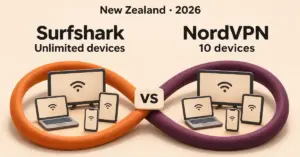
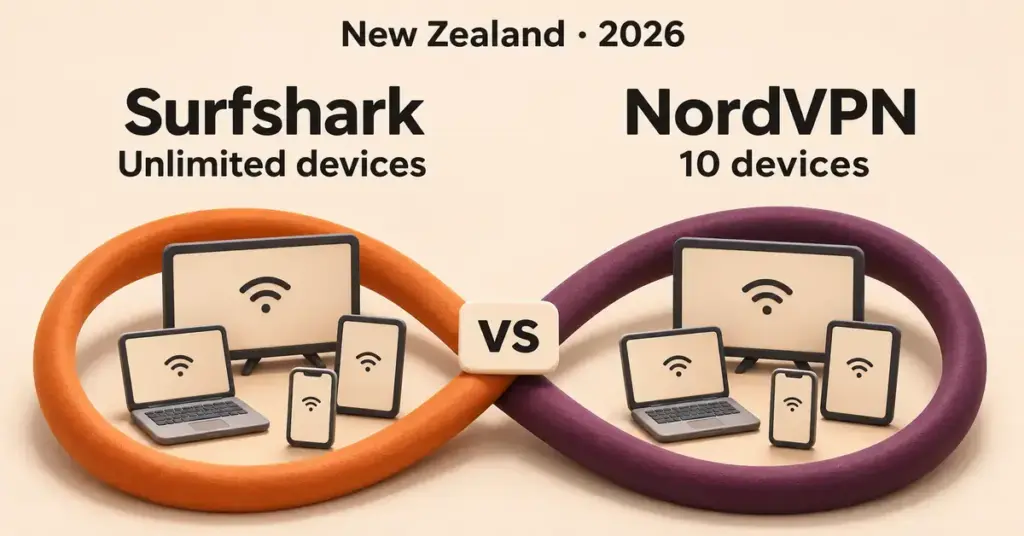
This is one of the clearest differences. Surfshark allows unlimited simultaneous connections, so one subscription can cover every device in a flat or household, including phones, laptops, tablets and smart TVs. NordVPN caps you at 10 devices connected at once. Ten is plenty for most individuals, but for a large household or a share house, Surfshark’s unlimited model is a real advantage.
Both have polished, beginner-friendly apps for Windows, macOS, iOS, Android and the major browsers, plus router support. Day to day, neither is noticeably harder to use than the other.
Streaming in New Zealand
Both VPNs are reliable for streaming. Connecting to an Auckland server keeps you on New Zealand catalogues, while overseas servers let you reach international libraries where that is allowed by the service’s terms. NordVPN’s SmartPlay and Surfshark’s standard servers both handle the major platforms well in testing. If streaming is your main reason for subscribing, it is worth checking which local and overseas services you actually want before committing to a long plan.
Pricing
Both follow the same playbook: a low headline price on a long two-year term, higher one-year and monthly rates, and a renewal price that is higher than the introductory one. New Zealand customers are usually billed in US dollars, so check the NZD equivalent and the renewal price at checkout before you commit.
| Plan term | Surfshark (entry tier) | NordVPN (entry tier) |
|---|---|---|
| 2-year (per month) | from about US$2.49 | from about US$3.49 |
| Monthly | higher (mid-teens US$) | about US$14.99 |
| Money-back guarantee | 30 days | 30 days |
| Free trial | 7 days (iOS / Android) | varies by platform |
Surfshark is generally the cheaper entry point, especially once you factor in unlimited devices. NordVPN costs a little more but bundles more extras on its higher tiers. Both sell add-ons (antivirus, data-breach alerts, extra storage) in their top plans, so compare like-for-like tiers rather than just the cheapest sticker price. If you want to try NordVPN before paying, see how to get a NordVPN free trial, and remember both offer a 30-day money-back guarantee on direct purchases.
Which one suits you
- Choose Surfshark if you want the lower price, need to cover an unlimited number of devices, or are kitting out a whole household on one subscription.
- Choose NordVPN if you want the largest server network, a Panama jurisdiction outside the main intelligence alliances, more New Zealand servers, or the extra security tools on its higher tiers.
Because both are owned by the same company and both pass independent audits, neither is a risky choice. For most New Zealand users the decision comes down to budget and device count versus network size and jurisdiction. If you are open to other options, you can also compare how NordVPN stacks up against a different rival in our NordVPN vs ExpressVPN guide.
Common mistakes when choosing
- Judging on the headline price alone. The two-year promo rate is not what you pay at renewal, and the monthly plan costs several times more. Compare the renewal price and the term you will actually keep.
- Ignoring device limits. If more than ten devices need protecting at once, NordVPN’s cap can catch you out; Surfshark’s unlimited model avoids that.
- Assuming a VPN makes illegal activity legal. Using a VPN is legal in New Zealand, but anything that is illegal without one stays illegal with one.
- Buying a long plan before testing. Use the money-back guarantee or a free trial to confirm speeds and streaming work for you before committing to two years.
Sources
Frequently Asked Questions
Is Surfshark or NordVPN better for New Zealand?
Both work well in New Zealand and have Auckland servers. Surfshark is usually cheaper and allows unlimited devices, while NordVPN has a larger server network, more New Zealand servers and a Panama jurisdiction outside the main intelligence alliances. The better choice depends on whether price and device count or network size and jurisdiction matter more to you.
Are Surfshark and NordVPN owned by the same company?
Yes. Since a 2022 merger, both brands sit under the same parent company, Nord Security. They still operate as separate products with their own apps, networks and pricing, but they share an owner.
Which is faster, Surfshark or NordVPN?
Speeds are close because both use the WireGuard protocol (NordVPN’s version is called NordLynx). On a fibre connection to a nearby Auckland server, either should feel close to your normal speed. Real-world differences depend more on your broadband, server distance and time of day than on the brand.
Is it legal to use a VPN in New Zealand?
Yes, using a VPN is legal in New Zealand. However, a VPN does not make otherwise illegal activity lawful, and you remain bound by New Zealand law and your internet provider’s terms while connected.
Which VPN is cheaper?
Surfshark usually has the lower entry price on its two-year plan and includes unlimited devices, making it the better-value pick for most households. NordVPN costs a little more but bundles more extra security tools on its higher tiers. Both renew at a higher price than the introductory rate, so check the renewal cost before subscribing.