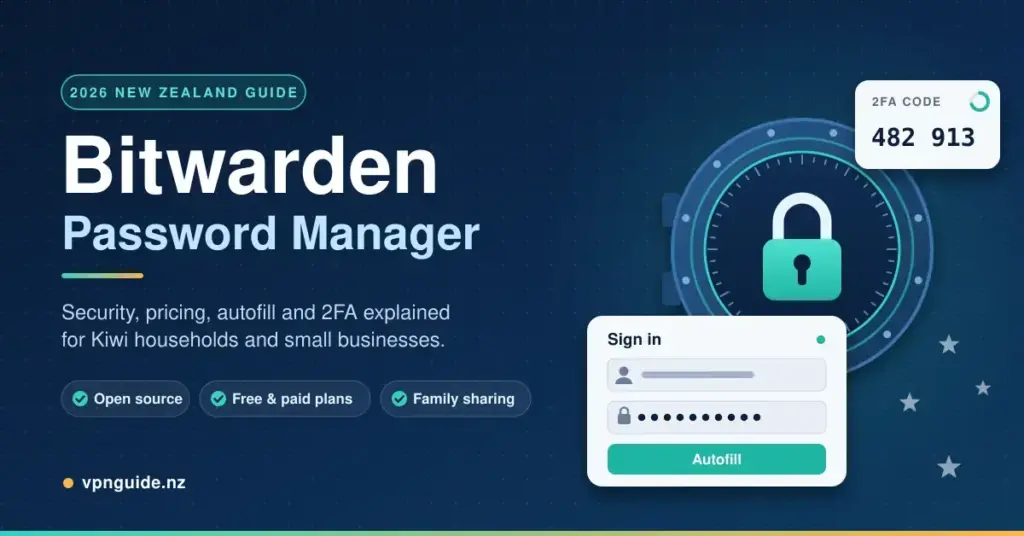
Choosing where to keep your logins has become one of the more important digital decisions a Kiwi household or small business can make. Bitwarden is one of the world’s most widely used open-source credential vaults, and this guide takes a practical, New Zealand–focused look at how it actually performs day to day. Whether you are an Auckland professional protecting business accounts, a Dunedin student juggling university portals, or a Christchurch family sharing a few logins, the aim here is simple: explain what the tool does, what it costs in local terms, and whether it is a sensible fit. If you are still weighing up the category as a whole, our broader password manager guide for New Zealand is a useful companion read.
Below we walk through the security model, the difference between the free and paid tiers, everyday features such as autofill and two-factor authentication (2FA), sharing options for families and teams, and the small rough edges worth knowing about before you commit. Every figure and feature here was checked against Bitwarden’s official documentation in 2026.
Key Points
- Open source and audited: the code is public on GitHub and checked by annual third-party audits from firms such as Cure53.
- Zero-knowledge encryption: 256-bit AES with PBKDF2 or Argon2id means your master password never leaves your device.
- Generous free tier: unlimited stored logins synced across unlimited devices, plus free two-person sharing.
- Affordable Premium: US$19.80 per year adds integrated 2FA codes, vault health reports, emergency access and 5 GB of encrypted storage.
- Works everywhere: apps for Windows, macOS, Linux, iOS and Android, plus Chrome, Firefox, Safari and Edge extensions.
- Optional self-hosting: advanced users can run the whole server on their own hardware.
What Is Bitwarden?
Bitwarden is an open-source credential manager that stores, generates and autofills your passwords, passkeys and other sensitive details. It is built around end-to-end, zero-knowledge encryption, which means the contents of your vault are scrambled on your own device before anything is uploaded. Your master password is the only key that can unlock it, and because that key never leaves your device in a readable form, not even Bitwarden’s own staff can see what you store. For everyday New Zealanders, that translates to online banking details, IRD logins and personal records that stay unreadable even if a server is breached.
The term “open-source” simply means the underlying software code is published publicly rather than kept secret. Unlike some long-standing rivals that have steadily trimmed their free offerings, Bitwarden keeps a genuinely useful free tier that handles website logins, secure notes, payment cards and identity profiles. The project is maintained by a commercial company, Bitwarden, Inc., alongside a global community of contributors, so security fixes and new features arrive at a steady pace.
Why Open Source Matters for Privacy
For privacy-minded users across Aotearoa, the open code is reassuring. A closed, proprietary product asks you to simply trust that its internal team has done the security work correctly. With Bitwarden, the code sits publicly on GitHub, so independent researchers can inspect it for hidden flaws or backdoors. On top of that community scrutiny, Bitwarden commissions annual third-party audits from external security firms such as Cure53 and Insight Risk Consulting, and runs a public bug-bounty programme. If you want a deeper primer on protecting yourself online, our cyber security guide for New Zealand puts tools like this in context.
| Feature | Typical closed-source rival | Bitwarden (open source) |
|---|---|---|
| Code transparency | Proprietary and hidden | Public and inspectable |
| Independent auditing | Occasional private reviews | Annual public third-party audits |
| Community contributions | Internal team only | Worldwide contributor base |
| Data autonomy | Vendor cloud only | Optional self-hosting |
Core Features in Everyday Use
In daily use, Bitwarden handles the basics precisely. Its built-in generator can produce long random strings or memorable passphrases, and it saves each new login as you create it. It also includes Bitwarden Send, an encrypted way to hand a snippet of text or a file to someone else without exposing it through ordinary email or messaging. The interface across platforms is clean and functional rather than flashy: the desktop apps for Windows and macOS mirror the web vault, with a sidebar for Logins, Secure Notes, Cards and Identities that you can further sort into folders.
Quick Facts
| Developer | Bitwarden, Inc. |
| Official download | bitwarden.com/download |
| Licence | Free tier available; Premium from US$19.80/year; open source (GPLv3/AGPLv3) |
| Operating systems | Windows, macOS, Linux, iOS, Android, plus Chrome/Firefox/Safari/Edge extensions and web vault |
| File size | Varies by platform |
| Encryption | 256-bit AES with PBKDF2 SHA-256 or Argon2id key derivation |
| Families plan | US$47.88/year for up to 6 people |
Browser Extensions and Mobile Apps
For most people, the browser extension is the main point of contact with their vault. Available for Chrome, Firefox, Safari and Edge, it sits in the toolbar, notices when you reach a saved login page and offers to fill your details with a click or keyboard shortcut. On iOS and Android, the app hooks into the phone’s own biometrics, so you can unlock the vault with Face ID, Touch ID or a fingerprint sensor rather than retyping your master password each time.
- Biometric unlock: works with Face ID, Touch ID and Android fingerprint sensors for quick access.
- Auto-save prompts: offers to store new or changed passwords the moment you create an account.
- URI matching: fills credentials only on domains that match your saved entry, which helps block lookalike phishing sites.
- On-device generator: create a strong passphrase straight from the mobile app when signing up for something new.
Free vs Premium: Which Tier Suits New Zealanders?
The choice between tiers comes down to how many extra security features you actually want. The free plan is unusually generous: unlimited stored items synced across an unlimited number of devices. That alone is a meaningful upgrade over rivals that cap free accounts to a single device type, and for many households the free tier is genuinely enough.
Premium, billed annually at US$19.80 per year (about NZ$33 depending on the exchange rate), adds the features that matter most for tighter security: an integrated authenticator that generates Time-based One-Time Password (TOTP) 2FA codes, vault health reports that flag weak or reused passwords, emergency access for a trusted contact, hardware-key support such as YubiKey and FIDO2, and 5 GB of encrypted file storage. Prices and inclusions were refreshed in January 2026, so it is worth cross-checking Bitwarden’s own page; our dedicated Bitwarden pricing and plans guide breaks the tiers down further. Bitwarden also offers a free standalone app, Bitwarden Authenticator, for anyone who prefers to keep their 2FA codes separate from the vault; our Bitwarden Authenticator guide compares the two approaches.
Free Tier Versus Premium at a Glance
| Capability | Free plan | Premium (individual) |
|---|---|---|
| Stored items | Unlimited | Unlimited |
| Device syncing | Unlimited devices | Unlimited devices |
| Password generator | Included | Included |
| Bitwarden Send | Text only | Text and files |
| Advanced 2FA options | Authenticator app, email | YubiKey, FIDO2, Duo |
| Integrated TOTP generator | Not included | Included |
| Vault health reports | Not included | Included |
| Emergency access | Not included | Included |
| Encrypted file storage | Not included | 5 GB |
Security Architecture and Zero-Knowledge Encryption
At its core, Bitwarden uses 256-bit AES (Advanced Encryption Standard) to lock your data before it leaves your device. That is paired with a key-derivation function — either PBKDF2 SHA-256 or the newer, more resistant Argon2id — which turns your master password into the encryption key in a way that makes brute-force guessing extremely slow and costly for an attacker. A key-derivation function is essentially a deliberate slowdown: it makes each password guess expensive to compute, so mass guessing becomes impractical.
Because that key is created entirely on your own device, your master password is never sent across the internet or stored on Bitwarden’s servers. This is what “zero-knowledge” means in practice: even if the cloud servers were fully breached, an attacker would come away with scrambled data that cannot be unlocked without your specific master password.
Why Your Master Password Is Everything
The flip side of zero-knowledge design is that there is no “forgot password” reset and no help desk that can let you back in. If you forget your master password and have not set up an emergency contact or a recovery method, your vault becomes permanently inaccessible. A few sensible habits remove almost all of that risk.
- Keep an offline backup: write your master password and account recovery details on paper and store them somewhere secure at home.
- Set up emergency access: on Premium, nominate a trusted family member who can request access if something happens to you.
- Use passkeys where you can: modern passkey support lets you sign in without typing long strings each time.
- Export periodically: download an encrypted export of your vault now and then and keep it on an offline drive.
Setting Up Your Vault in New Zealand
Getting started usually takes under ten minutes. Create an account on the official website or download the app from the Apple App Store or Google Play, then set a master password that is long, unique and used nowhere else. From there the setup flow walks you through enabling browser autofill and mobile biometrics. If you are moving away from browser-stored passwords, Bitwarden’s import tool reads directly from Chrome, Safari and Edge, as well as exports from rivals such as LastPass and 1Password.
A clean migration is worth doing carefully. Export your old passwords to a CSV or JSON file, import them into Bitwarden, confirm everything transferred, and then securely delete the export file — a plain-text export of every password you own is exactly the sort of file you do not want lingering in your Downloads folder.
Mastering Autofill and Daily Use
Once your vault is populated, autofill is where the time savings appear. By default Bitwarden avoids filling fields automatically on page load, since invisible or malicious forms can abuse that behaviour; instead it prefers explicit triggers you control. On desktop, the fastest route is the keyboard shortcut Ctrl + Shift + L on Windows, or Cmd + Shift + L on macOS, which identifies the site, pulls the matching login and fills it instantly without opening the extension menu.
For people who juggle personal and work accounts, Bitwarden handles multiple profiles cleanly. You can keep separate card entries for personal and business spending, and store several identity profiles to speed up online forms.
- Custom fields: add extra text, hidden values or checkboxes to individual entries for unusual corporate logins.
- Match detection: adjust URI matching from “base domain” to “exact” for fussy platforms.
- Folders: group entries into clear sections such as Banking, Utilities, Entertainment and Work.
- Quick search: use the extension’s search bar to find a note or card PIN without leaving your current tab.
Two-Factor Authentication and Passkeys
A username and password alone are no longer enough for important accounts, and Bitwarden doubles as a capable 2FA hub. On Premium, the built-in authenticator stores the secret keys for your accounts and shows the rotating six-digit TOTP codes right beside the matching login. When you autofill a site that asks for a second code, Bitwarden copies the current code to your clipboard automatically, so you can paste it straight in rather than reaching for a separate app on your phone.
Bitwarden also supports passkeys, letting you create, store and sync them inside your vault. Passkeys use public-key cryptography to prove who you are without sending any reusable secret over the network, which makes them strongly resistant to phishing. Our guide to using passkeys in Bitwarden covers the practical setup.
| Method | Security | Phishing resistance | Convenience |
|---|---|---|---|
| Password only | Low | None | Medium |
| Password + SMS code | Medium (SIM-swap risk) | Low | Low |
| Password + app TOTP | High | Medium | Medium |
| Integrated vault TOTP | High | Medium | High |
| Passkeys | Very high | Strong | High |
Sharing for Families and Businesses
Households and small businesses often need to share a login safely — a family’s streaming account or a small firm’s accounting portal, say. Writing passwords on sticky notes or texting them around is exactly the habit a vault is meant to replace, and Bitwarden handles sharing through what it calls “Organizations”. The free plan includes a two-person Organization, letting you share up to two collections of logins with one other trusted person at no cost. The Bitwarden project has kept this free sharing option in place through 2026.
For larger households, the Families plan covers up to six people for US$47.88 per year and lifts the collection limits, giving everyone their own Premium features under one subscription. Businesses can step up to the Teams and Enterprise plans, which add central admin controls.
Managing Credentials Across a Team
The business tiers give IT administrators the levers they need to keep an organisation tidy and compliant.
- Granular permissions: grant read-only, hide-password or full-edit rights to specific people or departments.
- Event logs: keep an audit trail of administrative activity for compliance.
- Directory sync: provision users automatically from Azure Active Directory, Google Workspace or Okta.
- Single sign-on: integrate with existing SSO providers so staff log in through familiar company accounts.
Bitwarden in the New Zealand Context
Bitwarden works with every major local internet provider — Spark, One NZ, 2degrees and Chorus fibre networks — and its sync traffic is light, so vault changes made on home fibre appear almost instantly on a phone using mobile data. There is nothing NZ-specific to configure; it simply captures and fills login fields for the local banks, insurers and government portals you use.
The real local benefit is compartmentalising your identity. By giving every account its own long, random password, a breach at one minor retailer cannot cascade into your banking or government logins.
- Banking: works across ANZ, ASB, BNZ, Westpac NZ and Kiwibank web and mobile logins.
- Government: stores access details for RealMe, IRD’s myIR and ACC services.
- Utilities: keeps household logins for Mercury, Genesis, Contact Energy and local fibre providers tidy.
- Investing: locks down access to platforms such as Sharesies, Hatch and Kernel.
Rough Edges Worth Knowing
No tool is flawless. For complete newcomers, terms like “Organizations”, “Collections” and “cipher” can feel technical during setup. The interface is functional rather than polished, and lacks some of the guided onboarding of pricier rivals. Moving a password from your personal vault into a shared collection also takes a few more steps than some people expect — a deliberate friction that prevents accidental oversharing.
None of this is hard to get past once the basic logic clicks, and Bitwarden’s community forum and documentation are strong self-help resources. If you want to see how it stacks up against a more design-led competitor, our Bitwarden vs 1Password comparison is a good next step.
- Functional design: built for speed and stability rather than visual polish.
- Deliberate sharing steps: moving items into shared collections needs an assignment, by design.
- Some hygiene tools are paid: detailed vault health reporting sits on the Premium tier.
- Self-hosting is advanced: running your own server is powerful but not a beginner task — see our self-hosting deployment guide.
Who Bitwarden Suits Best
Bitwarden lands as a secure, low-cost and genuinely capable vault for people across New Zealand. Its open-source transparency and a free tier that syncs across unlimited devices make it easy to recommend to anyone tightening up their online security. The interface is plain and asks for a short learning curve, but the underlying encryption is solid and independently audited. For those who upgrade to Premium or a Families plan, the integrated TOTP codes, vault health reports and encrypted file storage add real value at a price that stays well below most rivals. If you are comparing the whole field first, start with our wider password manager guide and come back once you have shortlisted a couple of options.
Sources
- Bitwarden — Personal plan pricing
- Bitwarden Help — Password Manager plans
- Bitwarden Help — Organizations quick start (free two-person sharing)
- Bitwarden — Family password manager
- Bitwarden Blog — Annual third-party security audits
- Bitwarden Help — Encryption used (AES-256, PBKDF2, Argon2id)
- Business Wire — Bitwarden enhances Premium and Families plans (January 2026)
Frequently Asked Questions
Is Bitwarden safe for storing my online banking passwords in New Zealand?
Yes. Bitwarden uses zero-knowledge 256-bit AES encryption, so your data is scrambled on your own device before it reaches the cloud. Neither Bitwarden nor an attacker who breaches a server can read your bank logins without your master password.
Can I use the free version on my laptop and phone at the same time?
Yes. Unlike several rivals that restrict free users to one device type, Bitwarden’s free plan syncs unlimited items across an unlimited number of devices at once.
What happens if I forget my master password?
Because of the zero-knowledge design, Bitwarden does not store your master password and cannot reset it. If you lose it and have not set up emergency access or a recovery method, your vault cannot be recovered — so keep an offline backup.
How much does Bitwarden Premium cost for New Zealanders?
Premium is US$19.80 per year (about US$1.65 a month, billed annually), which works out to roughly NZ$33 depending on the exchange rate. The Families plan covers six people for US$47.88 per year. Always check Bitwarden’s current pricing before you subscribe.
Can I share a streaming or utility password with my partner on a free account?
Yes. The free plan includes a two-person Organization, letting you create up to two collections and share logins securely with one other trusted person without paying.
Can I host my own Bitwarden server in New Zealand?
Yes. Because Bitwarden is open source, advanced users can self-host the whole server on their own hardware or private cloud for maximum control over where the data lives.