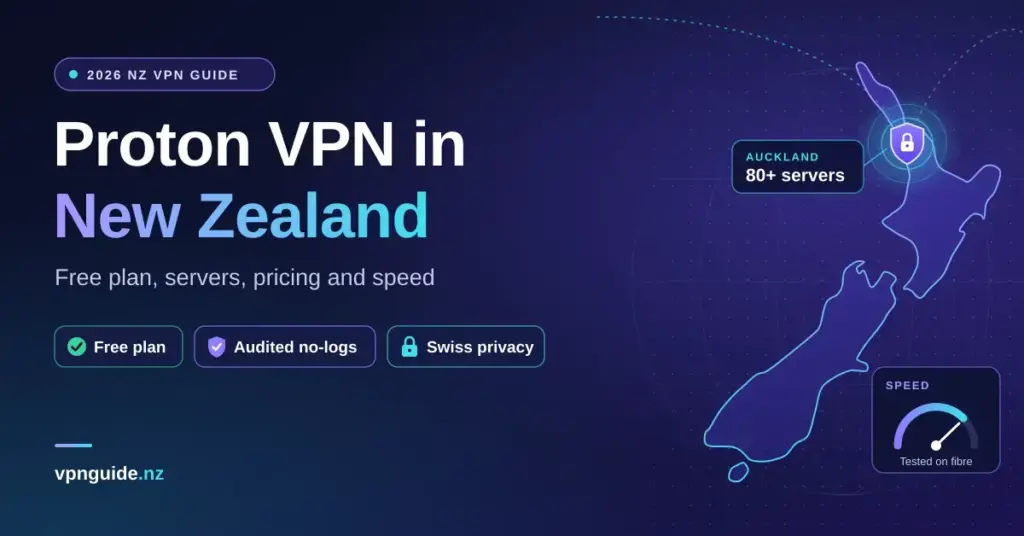
Proton VPN is the Swiss VPN built by the team behind Proton Mail, and it is one of the few mainstream providers that pairs an independently audited no-logs policy with a genuinely usable free plan. This guide looks at how it works for people connecting from New Zealand: the free tier, the Auckland servers, current pricing in US dollars, realistic speeds on a fibre line, and how it lines up against the other providers Kiwis tend to shortlist.
Quick facts
| Developer | Proton AG (Geneva, Switzerland) |
| Official download | protonvpn.com/download |
| Latest independent audit | Fifth consecutive annual no-logs audit (Securitum, 2026) |
| Licence | Free plan plus paid subscriptions; apps are open source |
| Platforms | Windows, macOS, Linux, Android, iOS, and routers (manual config) |
| Jurisdiction | Switzerland — outside the Five, Nine and Fourteen Eyes alliances |
| New Zealand servers | More than 80 in Auckland (paid plans) |
| Money-back guarantee | 30 days on paid plans |
Proton VPN at a glance: strengths and trade-offs
The quick summary below comes before the detail so you can decide whether the rest is worth reading. It is framed as measurable facts rather than a score.
| Strengths | Trade-offs |
|---|---|
| Free plan with no data cap and no ads | Free plan gives one device and no choice of country |
| Open-source apps and a fifth consecutive independent no-logs audit (Securitum, 2026) | Monthly billing is expensive; the low prices need a one- or two-year plan |
| More than 80 servers in Auckland, plus Secure Core, NetShield, Stealth and port forwarding | Secure Core and Tor routing cut speeds noticeably |
| Swiss jurisdiction, outside the Five Eyes alliance | Support is email-based; no phone line |
| 30-day money-back guarantee on paid plans | Streaming access is good but not as consistent as ExpressVPN or NordVPN |
What Proton VPN is and why it matters for New Zealand users
Proton VPN is run by Proton AG, headquartered in Geneva. For New Zealand users it is one of the few mainstream VPNs that combines an audited no-logs policy, open-source apps and a usable free tier, all governed by Swiss privacy law rather than the jurisdiction of a Five Eyes country. Since August 2025 Proton has been moving some of its infrastructure to Germany and Norway in response to proposed Swiss surveillance rules (the VUPF reform), but the company, its legal home and its policies remain Swiss. As of September 2026 the network spans over 20,000 servers across about 145 countries, including servers in New Zealand.
New Zealand is a founding member of the Five Eyes intelligence alliance, which means your internet activity can, in principle, be subject to signals-intelligence sharing between NZ, Australia, the United States, the United Kingdom and Canada. Your ISP — whether that is Spark, One NZ, 2degrees or a smaller fibre reseller on the Chorus network — is also subject to the Telecommunications (Interception Capability and Security) Act 2013, which requires providers to maintain lawful interception capability. A VPN does not make you invisible, but routing your traffic through a Swiss-jurisdiction provider operating under Swiss law meaningfully raises the legal bar for third-party access to your data.
The Privacy Act 2020 strengthened New Zealanders’ rights around personal data held by local organisations, but it does not govern what overseas services or intelligence partners do with traffic metadata. That gap is part of why privacy-conscious users in this country reach for tools like Proton VPN. For the wider picture, Netsafe’s guidance on using a VPN is a useful plain-English starting point.
How Proton VPN works
Proton VPN creates an encrypted tunnel between your device and one of its servers. All traffic leaving your device is encrypted before it reaches your ISP’s infrastructure, so Chorus, Spark’s backbone or whoever provides your last-mile connection sees only that you are connected to a Proton VPN endpoint — not what sites you visit or what data you transfer.
The service supports several protocols. WireGuard is the default on most platforms and delivers the best balance of speed and security on a modern NZ fibre connection. OpenVPN (UDP and TCP variants) is more established and useful if you need to traverse restrictive firewalls. Stealth is Proton’s obfuscated protocol, designed to disguise VPN traffic as ordinary HTTPS — relevant if you are travelling to a country that actively blocks VPN connections. Our WireGuard vs OpenVPN comparison explains which to pick.
Proton’s architecture also includes a feature called Secure Core, which routes your traffic through hardened servers in privacy-friendly jurisdictions — Switzerland, Iceland and Sweden — before it exits to the destination country. This adds latency but provides meaningful protection against endpoint compromise: if the exit server in, say, the United States is monitored, the traffic can only be traced back to the Secure Core relay, not to your New Zealand IP address.
The apps are fully open source and have been independently audited, and the no-logs policy itself has now been checked five years running, most recently by Securitum in 2026 following an on-site review of Proton’s production infrastructure in Zurich. The audit reports are published in full and the code is on GitHub, which is more than most providers offer; you can read the summaries of the independent no-logs audits yourself.
Setting up Proton VPN on a New Zealand connection
Getting Proton VPN running on a typical NZ home setup is straightforward. The following steps apply to the desktop client on Windows or macOS; the mobile apps follow the same logic.
- Create a Proton account at proton.me. The free tier requires only an email address.
- Download the Proton VPN app for your platform from proton.me/vpn/download. Avoid third-party sources.
- Sign in and open Settings. Under Connection, set the protocol to WireGuard for everyday use on a Chorus fibre or Hyperfibre connection.
- Enable the Kill Switch. This blocks all internet traffic if the VPN tunnel drops unexpectedly, preventing your real IP from leaking to your ISP.
- For server selection, pick New Zealand (Auckland) as your default if the goal is privacy from your ISP with the least latency; Proton runs more than 80 servers there. Choose Australia (Sydney or Melbourne) if you want an overseas IP with minimal delay: the Auckland-to-Sydney round trip sits at roughly 28 to 34 ms, which is imperceptible for most tasks.
- If you need a US IP address — for example, to access a US-only streaming library — select a US server. Expect a minimum round-trip latency of around 140 ms to the US West Coast from Auckland; this is a function of physics and fibre routing, not Proton’s infrastructure.
- Enable NetShield (available on paid plans) for DNS-based ad and malware blocking. This works at the VPN level, so it applies across all apps on your device, not just your browser.
If you are running Proton VPN on a router — useful for covering smart TVs, consoles and other devices that cannot run a VPN app natively — the service supports OpenVPN and WireGuard configuration files for manual router setup. Asus routers running Merlin firmware and GL.iNet travel routers handle this well. Note that router-level VPN consumes CPU on the router itself; budget hardware may bottleneck your connection well before Proton does.
For most New Zealand households on Chorus fibre, WireGuard to a Sydney server is a sensible default. Use Secure Core only when you specifically need the additional anonymity layer — it will reduce throughput noticeably.
NZ-specific considerations: ISPs, speeds and data caps
New Zealand’s fibre rollout through Chorus and the smaller local fibre companies (Enable in Christchurch, Tuatahi First Fibre in the Waikato and Bay of Plenty, Northpower in Northland) means most urban households can get gigabit-class connections, and Hyperfibre plans now reach 8 Gbps. Chorus counted 1.147 million fibre connections at the end of June 2026, with more than 80 percent of its fibre customers on 500 Mbps or faster plans. On a connection like that, the VPN overhead is the constraint, not your line. It is worth running an NZ speed test with the VPN on and off to see the difference on your own connection.
As a rough guide, on a 900/500 Mbps Hyperfibre line from Auckland with WireGuard enabled and the server set to Sydney, you would typically see download speeds in the 700-850 Mbps range and uploads in the 400-480 Mbps range, with the VPN adding roughly 2-5 ms of latency on top of the base round-trip. These are realistic expectations based on WireGuard’s known performance characteristics and typical Auckland-to-Sydney routing; independent latency measurements from Auckland give a sense of the base numbers before any VPN is involved. Your results will vary with server load and your ISP’s peering.
For users on rural fixed wireless (Starlink, Spark’s wireless broadband or One NZ’s rural network), the base latency is already higher — Starlink typically sits at 25-60 ms to nearby ground stations — so the VPN overhead is proportionally less significant. WireGuard remains the right choice here.
Data caps are largely a non-issue for urban fibre users in 2026, as most plans are unlimited. If you are on a capped mobile data plan and using Proton VPN on your phone, be aware that VPN encapsulation adds a small overhead (typically 5-10 percent) to your data consumption. This is not Proton-specific — it applies to all VPN protocols.
One practical NZ consideration is split tunnelling. Proton’s desktop and Android apps support it, letting you route specific apps or domains outside the VPN. This is useful if you want Proton for general browsing but need NZ-based services — TVNZ+, ThreeNow, Neon, Sky Sport Now or Whakaata Maori — to see your real NZ IP, avoiding geo-detection issues those services can apply to foreign-looking addresses. For general online safety beyond the VPN itself, the New Zealand Police internet safety advice is a solid reference.
Proton VPN plans and pricing in NZD terms
Proton VPN has a free tier and two paid tiers. It bills in USD or EUR, so the NZD amount moves with the exchange rate; the prices below are the USD rates Proton lists on its plans and pricing page, and the first figure in each cell is what you pay on a one-month plan.
| Plan | USD price (monthly / 1 year / 2 years) | Devices | Servers | Key features |
|---|---|---|---|---|
| Free | US$0 | 1 | 10 countries, auto-selected | No logs, no ads, no data cap, no country choice, no streaming or P2P servers |
| VPN Plus | US$9.99 / US$3.99 / US$2.99 per month | 10 | About 145 countries, 20,000+ servers | Streaming servers, NetShield, Secure Core, P2P, Tor over VPN |
| Proton Unlimited | US$12.99 / US$9.99 / US$7.99 per month | 10 | Same as Plus | VPN Plus + Proton Mail, Drive, Calendar, Pass (full Proton suite) |
The free tier is functional for basic privacy use rather than a crippled trial. There is no data cap and no artificial speed cap, but free users are placed on lower-priority servers in one of ten countries chosen automatically, and cannot use the streaming or P2P servers. For a New Zealander who simply wants to encrypt traffic on public Wi-Fi at a cafe or airport, the free plan is enough. Paid plans carry a 30-day money-back guarantee.
If you want to unblock international streaming catalogues or use P2P file sharing, VPN Plus is the minimum. Proton Unlimited makes sense if you are already using or considering Proton Mail — the bundle is competitive against paying for each service separately. To see how Proton stacks up against the other providers we cover, our best VPN for New Zealand guide ranks them side by side, and the free VPN guide explains why Proton’s free plan is one of the few we recommend.
Streaming and content access from New Zealand
One of the most common reasons New Zealanders use a VPN is to access streaming libraries not available locally. Proton’s paid streaming servers are designed to work with major platforms, and in practice they perform reliably with Netflix US, BBC iPlayer and Disney+. Results with other platforms vary and can change as streaming services update their detection methods.
For NZ-based streaming services, the situation is reversed: if you are overseas and want to watch TVNZ+, ThreeNow or Sky Sport Now, you need a VPN with a New Zealand exit server. Proton does have NZ servers on paid plans, which makes this possible. The same applies to Neon and Whakaata Maori, both of which geo-restrict their content to New Zealand IP addresses.
One practical note: TVNZ+ and ThreeNow use Akamai CDN infrastructure, which is reasonably good at detecting and blocking known VPN IP ranges. No VPN maintains a 100 percent success rate with these services indefinitely. If access fails, switching to a different Proton server in the same country usually resolves it.
Key points
- Proton VPN is run from Switzerland, which sits outside the Five Eyes alliance New Zealand belongs to, raising the legal bar for third-party access to your traffic.
- The no-logs policy has passed a fifth consecutive independent audit (Securitum, 2026), and the apps are open source.
- The free plan has no data cap and no ads, but limits you to one device and ten auto-selected countries, with no streaming or P2P servers.
- VPN Plus starts at about US.99/month on a two-year plan; Proton Unlimited adds Proton Mail, Drive, Calendar and Pass.
- On Chorus fibre, WireGuard to a Sydney server is a sensible everyday default; Secure Core adds privacy but noticeably cuts speed.
- Paid NZ (Auckland) servers let you keep a New Zealand IP for TVNZ+, ThreeNow, Neon and Sky Sport Now while travelling.
How Proton VPN compares to the alternatives
New Zealand users evaluating Proton VPN will likely also consider ExpressVPN, NordVPN, Mullvad and Surfshark. Each has a different profile.
| Provider | Jurisdiction | Long-plan price (USD/month) | Open-source apps | Free tier | NZ servers |
|---|---|---|---|---|---|
| Proton VPN | Switzerland | From US$2.99 (2 years) | Yes | Yes | Yes (paid) |
| Mullvad | Sweden | Flat EUR 5 | Yes | No | Yes (Auckland) |
| NordVPN | Panama | From US$3.49 (2 years) | Partial | No | Yes |
| ExpressVPN | British Virgin Islands | Roughly US$3 to 5 on long plans | No | No | Yes |
| Surfshark | Netherlands | From US$2.49 (2 years) | No | No | Yes |
Mullvad is the closest competitor on privacy principles: it accepts cash and anonymous account numbers, runs WireGuard only and charges a flat EUR 5 a month, but it has no free tier and no streaming focus. NordVPN and Surfshark are cheaper on long-term plans and both have Deloitte-audited no-logs policies, but they belong to the same parent company (Nord Security) and their apps are not fully open source. ExpressVPN is the smoothest for streaming but costs more. Proton’s combination of Swiss jurisdiction, open-source audited apps, a functional free tier and its Auckland servers makes it the strongest all-round option for New Zealanders who want a privacy-first provider.
Who Proton VPN suits
Proton VPN is the most well-rounded choice for New Zealand users who take privacy seriously. Its Swiss jurisdiction provides legal distance from the Five Eyes framework that governs New Zealand’s intelligence environment, its apps are open source and its no-logs policy has now been audited five years in a row, and it is one of the only providers offering a credible free tier alongside a competitive paid plan. VPN Plus at US$2.99 to US$3.99 a month on a long plan covers what most people need: Auckland and overseas servers, streaming and P2P access, ten devices and NetShield ad blocking. Proton Unlimited makes sense if you also want Proton Mail, Drive, Calendar and Pass under one subscription. It is not the cheapest option, but for a product where trust in the provider is the whole point, Proton has done more than most to make that trust verifiable.
Reference sources
- TechRadar — Proton VPN passes its fifth consecutive independent no-logs audit
- CyberInsider — Proton VPN passes no-logs audit that found no user-activity retention
- heise online — Proton relocates parts of its infrastructure from Switzerland
- Security.org — How much does Proton VPN cost in 2026
- Proton VPN — Secure Core feature overview
- Telecoms.com — Chorus fibre uptake and connection figures
Frequently asked questions (FAQ)
Is Proton VPN legal in New Zealand?
Yes. Using a VPN is entirely legal in New Zealand. There is no legislation under the Telecommunications Act, the Privacy Act 2020 or the Broadcasting Standards Act that prohibits VPN use. The legality of what you do while connected is a separate question — a VPN does not change the legal status of your activities.
Does Proton VPN keep logs of my activity?
Proton VPN operates under a no-logs policy that has been independently audited five years running, most recently by Securitum in 2026. Because it is headquartered in Switzerland, it is not subject to New Zealand’s Telecommunications (Interception Capability and Security) Act or to Five Eyes data-sharing arrangements. Swiss law does not require VPN providers to retain user activity logs, and Proton publishes transparency reports detailing the legal requests it receives and how it responds.
Will Proton VPN slow down my Chorus fibre connection?
On a standard gigabit fibre connection the impact is minimal when using WireGuard. Expect throughput in the 700-850 Mbps range on a 900 Mbps line when connected to a Sydney server — a reduction you are unlikely to notice during normal use. Secure Core routing reduces speeds more significantly because of the additional relay hop. On VDSL or fixed-wireless connections with lower base speeds, the overhead is proportionally smaller and less noticeable.
Can I use Proton VPN to watch TVNZ+ or Sky Sport Now from overseas?
Proton VPN has New Zealand exit servers on paid plans, and connecting to one gives you a New Zealand IP address. This generally allows access to geo-restricted NZ services including TVNZ+, ThreeNow, Neon and Sky Sport Now. Success is not guaranteed indefinitely, as streaming platforms periodically update their VPN detection. If one NZ server is blocked, try another in the same location.
Is the Proton VPN free plan worth using?
For basic privacy protection — encrypting traffic on public Wi-Fi, hiding your browsing from your ISP — the free plan is genuinely useful and not artificially crippled. It covers one device, connects you automatically to a server in one of ten countries, and does not include streaming or P2P servers. It is not suitable for unblocking international streaming libraries or high-volume file sharing, but it is one of the most honest free VPN offerings available.
How does Proton VPN handle the Five Eyes issue for New Zealanders?
New Zealand’s membership in the Five Eyes alliance means NZ intelligence agencies can share data with counterparts in the US, UK, Australia and Canada. A VPN provider headquartered in New Zealand would be subject to domestic interception laws and could, in principle, be compelled to assist with surveillance. Proton’s Swiss base removes it from that legal framework — Switzerland is not a Five Eyes or Fourteen Eyes member, and Swiss law imposes strict requirements before any data can be disclosed to foreign governments. This does not make Proton surveillance-proof, but it substantially raises the legal threshold for access.