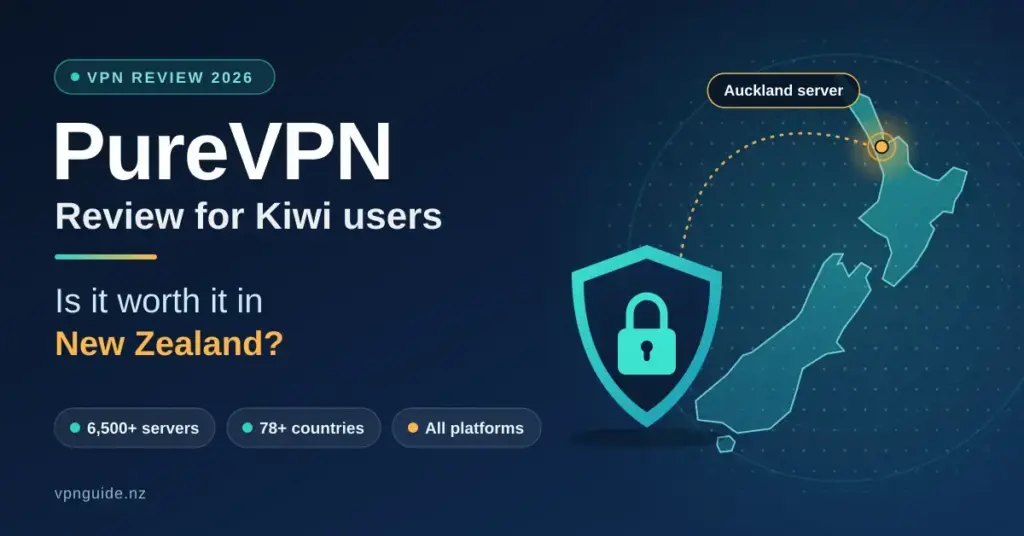
PureVPN is one of the longest-running commercial VPN services on the market, and it is fully available to New Zealand users in 2026. It runs on every major platform, encrypts your traffic through servers in 78+ countries — including, for the first time, a New Zealand location in Auckland — and sits in the affordable-to-mid tier on price. It is a legitimate, workable choice rather than a class leader, and it carries some historical baggage worth understanding. This guide walks through what PureVPN is, who runs it, how it performs on a Kiwi fibre connection, what it costs in real terms, and where it fits against the alternatives.
Quick Facts
| Developer | GZ Systems Ltd (PureSquare group) — purevpn.com |
|---|---|
| Official download | purevpn.com/download |
| Jurisdiction | British Virgin Islands (outside Five Eyes) |
| Licence | Commercial — paid subscription |
| Operating systems | Windows, macOS, iOS, Android, Linux; Chrome & Firefox extensions; routers |
| Network | 6,500+ servers, 78+ countries, ~96 locations (incl. Auckland, NZ) |
| Protocols | WireGuard, OpenVPN, IKEv2/IPSec |
| Simultaneous devices | 10 |
| Money-back guarantee | 31 days (card, PayPal, Google Pay, Apple Pay; not crypto) |
| No-logs audits | Altius IT (2019, 2024), KPMG (2021, always-on) |
What PureVPN is and who runs it
A VPN (virtual private network) routes your internet traffic through an encrypted tunnel to a remote server before it reaches the wider internet. To any website or app you visit, your connection appears to come from that server rather than from your home line in Auckland, Wellington or Christchurch. If you are new to the concept, our plain-English explainer on what a VPN does and does not do is a good starting point before you weigh up any single provider.
PureVPN is operated by GZ Systems Ltd, part of the PureSquare group, and is registered in the British Virgin Islands (BVI) after relocating from Hong Kong. That jurisdiction matters for New Zealand subscribers. The BVI has no mandatory data-retention laws and sits outside the Five Eyes intelligence-sharing alliance — the grouping of New Zealand, Australia, the United States, the United Kingdom and Canada — as well as the wider Nine Eyes and 14 Eyes arrangements. In plain terms, PureVPN is not legally compelled to keep connection logs and hand them to NZ agencies under the framework that would bind a provider incorporated in Wellington or Sydney.
The 2017 logging case and the audits since
PureVPN’s privacy history is the single most important thing a prospective user should understand, because it is genuinely mixed.
In October 2017, PureVPN supplied connection records to the FBI that helped identify Ryan Lin, a Massachusetts man later prosecuted in a serious cyberstalking case. At the time PureVPN marketed itself as a strict no-logs provider, so the fact that usable records existed at all contradicted its own claims and drew heavy criticism across the security press.
Since then the company has changed both its policy and its incorporation, and it has commissioned independent audits to rebuild trust:
- Altius IT (2019) — an early no-logs assessment of PureVPN’s systems.
- KPMG (2021) — a review of the no-logs policy, followed by an “always-on” arrangement under which KPMG can carry out surprise audits at any time.
- Altius IT (2024) — a further no-logs certification, which reported that PureVPN had no systems in place capable of identifying a specific user or their activity.
These audits are a meaningful improvement on the 2017 position, and the always-on model is stronger than a one-off report. Even so, the incident is worth knowing about, and anyone with a demanding threat model should read PureVPN’s current privacy policy and the audit summaries directly rather than relying on marketing language.
How PureVPN works and which protocols it uses
Once connected, PureVPN encrypts your traffic — typically with AES-256 — so your internet provider can see that you are connected to a VPN endpoint but cannot read the contents of what you send. It supports several tunnelling protocols, and your choice affects speed and compatibility. If you want the underlying detail, our comparison of WireGuard and OpenVPN covers the trade-offs.
- WireGuard — the fastest modern protocol; the best default for NZ fibre users who want maximum throughput.
- OpenVPN (UDP/TCP) — mature and widely compatible, slightly slower than WireGuard.
- IKEv2/IPSec — reconnects smoothly when a phone hops between Wi-Fi and mobile data, so it suits Spark, One NZ and 2degrees 5G.
- Legacy options (L2TP/IPSec, SSTP, PPTP) — kept for niche compatibility only; avoid them unless something specific requires it.
Apps are available for Windows, macOS, iOS, Android and Linux, with browser extensions for Chrome and Firefox and setup guides for compatible DD-WRT and Tomato routers. A router install protects every device on your home network at once — including smart TVs and game consoles — without loading the app onto each one.
Servers, and the new Auckland location
PureVPN advertises more than 6,500 servers across 78+ countries and roughly 96 locations. The most important recent change for Kiwis is that in 2026 the company added dozens of new locations, and New Zealand — an Auckland server — is now among them. This is a genuine shift from the situation a year earlier, when the closest options were in Australia (Sydney, Melbourne, Brisbane, Perth) and Singapore.
The practical upshot: if you need a New Zealand IP address — for reaching NZ-only services such as TVNZ+ or ThreeNow while you are travelling overseas, or for appearing local to a NZ site — PureVPN can now do that, where previously it could not. The Auckland node is currently listed as supporting IKEv2/IPSec and OpenVPN (TCP/UDP), so confirm in-app which protocol it offers if WireGuard is your preference. For everyday use inside New Zealand, the nearest Australian servers still give the lowest latency, with round-trip times around 25–35ms to Sydney (close to the physical floor of roughly 28ms across the Tasman).
Setting up PureVPN in New Zealand
The following applies to a standard Chorus fibre connection (from UFB up to Hyperfibre) with a modern router and a Windows or macOS device. The mobile flow is the same with a slightly different interface.
- Download the app from purevpn.com only. Avoid third-party download sites, which can bundle unwanted software.
- Create an account and pick a plan. The two-year plan has the lowest monthly cost; a monthly plan is handy for testing before you commit.
- Choose your protocol in Settings. Select WireGuard where it is offered — on a fast fibre line it preserves far more bandwidth than OpenVPN.
- Connect to Sydney or Melbourne for daily use, or to the Auckland server when you specifically need a New Zealand IP.
- Turn on the kill switch, which cuts your internet if the VPN drops so your real IP is never exposed.
- Run a DNS leak test (for example at dnsleaktest.com) and confirm the DNS servers shown belong to PureVPN, not to Spark, One NZ or your router’s default resolver.
- For overseas libraries, use PureVPN’s streaming-optimised or US servers for Netflix US and UK servers for BBC iPlayer, accepting that reliability shifts week to week.
Methodology note: the performance expectations here are based on the physical latency floor between New Zealand and each region (roughly 28ms to Sydney, about 138ms to the US West Coast and 170ms-plus to Europe) combined with typical WireGuard overhead. We do not publish fixed throughput numbers as live benchmarks, because real results vary with time of day, server load and your ISP’s international peering.
PureVPN pricing for New Zealand (2026)
PureVPN prices and bills in US dollars, not New Zealand dollars, so your card issuer applies the exchange rate and possibly a foreign-transaction fee. The NZD figures below are approximate, based on a rate near NZ$1.65–1.70 to US$1 during 2026. The headline rates are introductory and apply to the first term only — renewals cost more, which is the single most common surprise on any VPN bill.
| Plan | Billing | Intro price (USD) | Approx NZD/month | Notes |
|---|---|---|---|---|
| Standard | Monthly | ~US$12.95/mo | ~NZ$21–22 | No lock-in |
| Standard | 12 months | ~US$2.55/mo (~US$40.80 upfront) | ~NZ$4.20–4.40 | Renews higher (~US$57.95/yr) |
| Standard | 24 months | ~US$2.15/mo (~US$58.20 upfront) | ~NZ$3.50–3.70 | Lowest per-month rate |
| Plus | 24 months | ~US$2.73/mo | ~NZ$4.50–4.70 | Adds a password manager |
| Max | 24 months | ~US$3.55/mo | ~NZ$5.90–6.20 | Adds breach alerts and file encryption |
All plans allow up to 10 simultaneous device connections, which is generous. Payment options include credit and debit card, PayPal, Google Pay, Apple Pay and cryptocurrency. There is a 31-day money-back guarantee — a day longer than the industry-standard 30 — but note that refunds are not available on payments made with cryptocurrency, so use a card or PayPal if you want the trial safety net.
How PureVPN compares to key alternatives
PureVPN is not the only option, and for some users it will not be the best one. The table below sets it against the providers NZ readers most often shortlist. For a broader ranking, see our guide to the best VPN for New Zealand.
| Provider | Jurisdiction | NZ server | Approx NZD/month (annual) | Audited no-logs | Fast protocol |
|---|---|---|---|---|---|
| PureVPN | British Virgin Islands | Yes (Auckland, 2026) | ~$3.50–4.40 | Yes (KPMG, Altius IT) | WireGuard |
| ExpressVPN | British Virgin Islands | No (AU closest) | ~$18–22 | Yes (KPMG, Cure53) | Lightway |
| NordVPN | Panama | No (AU closest) | ~$7–10 | Yes (Deloitte) | NordLynx |
| Surfshark | Netherlands | No (AU closest) | ~$4–6 | Yes (Deloitte) | WireGuard |
| Mullvad | Sweden | No (AU closest) | ~$9 flat | Yes (Cure53, Assured) | WireGuard |
| Proton VPN | Switzerland | Yes (Auckland) | Free–~$14 | Yes (Securitum) | WireGuard |
If a New Zealand exit node is a priority, PureVPN and Proton VPN both now offer Auckland servers, as does Norton VPN. If audited transparency and a minimalist privacy model matter most, Mullvad is a strong pick at a flat monthly rate. PureVPN’s edge is price for the features on offer, especially on the two-year term.
Key Points
- PureVPN is a BVI-based, affordable-to-mid-tier VPN that works well for everyday privacy and overseas streaming from New Zealand.
- For 2026 it added an Auckland server, so it can now provide a New Zealand IP address — a change from previous years.
- It supports WireGuard, allows 10 devices, and carries a 31-day money-back guarantee (not on crypto payments).
- Prices are billed in US dollars; the lowest rate is on the two-year plan, and renewals cost more than the introductory price.
- The 2017 FBI logging incident is real history, but independent audits since (KPMG, Altius IT) have verified its current no-logs policy.
- For top-tier performance or transparency, Mullvad, NordVPN and Proton VPN are stronger alternatives.
Streaming from New Zealand: what works and what does not
Like every VPN in 2026, PureVPN’s streaming results are inconsistent because platforms invest heavily in VPN detection, and any specific unblocking claim can go out of date within weeks. In broad terms it performs reasonably for:
- Netflix US — usually works via streaming-optimised or US servers, though not every time.
- BBC iPlayer — UK servers generally work, with the occasional block that a server switch fixes.
- Amazon Prime Video — tends to be more reliable than Netflix, thanks to lighter VPN blocking.
- Disney+ — variable; US and UK libraries are reachable on good days.
New Zealand services behave differently. TVNZ+, ThreeNow, Neon and Sky Sport Now are locked to NZ IP addresses. If you are inside New Zealand connected to an overseas server, they will block you — so either disconnect, use split tunnelling to send those apps outside the tunnel, or connect to PureVPN’s new Auckland server. And if you are travelling abroad, the Auckland node is what now lets you reach TVNZ+ as if you were still at home. Our roundup of what to watch on Netflix in NZ is a useful companion once you are set up.
Security and privacy features
Beyond core encryption, PureVPN includes several features that matter for everyday NZ use:
- Kill switch — available on Windows, macOS, Android and iOS; prevents IP exposure if the tunnel drops during a brief network renegotiation.
- DNS leak protection — routes DNS queries through PureVPN’s own resolvers rather than your ISP’s; verify it with an independent leak test after setup.
- Split tunnelling — lets chosen apps bypass the VPN, useful for NZ banking apps (ASB, ANZ, BNZ, Westpac) that may flag VPN-originating logins.
- Obfuscation / stealth mode — disguises VPN traffic as ordinary HTTPS, relevant mainly when travelling to countries that restrict VPNs.
- Multi-hop — routes traffic through two servers for extra separation between you and the exit IP, at the cost of added latency.
- IPv6 leak protection — worth enabling on NZ fibre lines, where Chorus infrastructure increasingly hands out IPv6 addresses.
NZ considerations: ISP, jurisdiction and data
On a typical UFB plan (300/100 or 900/500 Mbps from Spark, One NZ or 2degrees), WireGuard to Sydney should comfortably support 4K streaming, video calls and large downloads without obvious slowdown; OpenVPN on the same line will be noticeably slower, especially on upload. On Hyperfibre, the ceiling is usually your device’s encryption throughput or PureVPN’s server capacity rather than the line itself. Most NZ residential fibre plans are unmetered, so running a VPN around the clock will not trigger overage — but on a capped mobile plan, remember that VPN encryption adds roughly 5–15% overhead to your data use.
On the legal side, New Zealand is a Five Eyes member, so choosing a provider incorporated outside the alliance — as PureVPN’s BVI base achieves — trims the theoretical exposure to alliance-level requests. For most people this is a theoretical rather than practical concern. Separately, the Privacy Act 2020 governs how organisations here handle your personal data; a VPN limits what your ISP can observe about your browsing, which is a legitimate privacy measure entirely consistent with NZ law. A VPN does not, however, defeat a lawful interception warrant directed at you personally.
Who PureVPN suits
PureVPN is a competent, keenly priced service that will cover everyday privacy and overseas streaming for most New Zealand users. Its BVI jurisdiction, post-audit no-logs policy, WireGuard support, 10-device allowance and — new for 2026 — an Auckland server make it a defensible choice at its price point. The main caveats are the 2017 history (context rather than a current disqualifier), streaming reliability that fluctuates as it does for every provider, and renewal prices that step up after the introductory term. If you want the strongest performance or the cleanest transparency record, Mullvad, NordVPN or Proton VPN are stronger overall. If you want a low-fuss, low-cost option that now includes a local NZ IP, PureVPN is well worth the 31-day guarantee to see whether it fits your connection and habits.
Sources
- PureVPN — official site, plans and features
- TechRadar — PureVPN adds 40+ server locations, including Auckland (2026)
- Tom’s Guide — PureVPN server-network upgrade
- VPNAlert — PureVPN pricing and plans (2026)
- Graham Cluley — VPN logs and the 2017 FBI cyberstalking case
- BetaNews — FBI used PureVPN records to track a suspect (2017)
- Netify — PureVPN New Zealand server details
Frequently Asked Questions (FAQ)
Is PureVPN legal to use in New Zealand?
Yes. Using a VPN is entirely legal in New Zealand for privacy, security or reaching overseas content. A VPN does not change the legal status of anything you do while connected, so illegal activity remains illegal regardless of the tunnel.
Does PureVPN have a New Zealand server now?
Yes. As part of a 2026 network expansion, PureVPN added an Auckland server, so it can now give you a New Zealand IP address — useful for reaching NZ-only services such as TVNZ+ from overseas, or for appearing local to NZ sites. Confirm in the app which protocol the Auckland node offers, as newer locations sometimes launch on IKEv2 and OpenVPN before WireGuard.
How fast is PureVPN on NZ fibre?
On a standard UFB 300/100 or 900/500 Mbps line, WireGuard to a Sydney or Auckland server should preserve enough throughput for 4K streaming, video calls and general browsing without noticeable slowdown, adding only a few milliseconds of latency. Connecting to US servers adds around 138ms at minimum, which affects real-time gaming but not streaming or downloads. OpenVPN is meaningfully slower than WireGuard on the same connection.
Is PureVPN really a no-logs VPN after the 2017 case?
PureVPN provided logs to the FBI in 2017 while marketing itself as no-logs, which was a genuine contradiction. Since then it has moved to the British Virgin Islands, rewritten its policy and passed independent no-logs audits by Altius IT (2019 and 2024) and KPMG (2021), the latter under an always-on arrangement allowing surprise checks. The current audited position is materially different from 2017, but the history is worth knowing before you decide how much to trust the brand.
How does PureVPN’s price compare in New Zealand?
On a two-year plan PureVPN is one of the cheaper mainstream options, at roughly NZ$3.50–4.40 per month before renewal, comparable to Surfshark and below NordVPN. ExpressVPN is far dearer at around NZ$18–22 per month, Mullvad charges a flat rate, and Proton VPN offers a genuinely usable free tier. Remember that PureVPN bills in US dollars and that renewal rates are higher than the introductory price.