
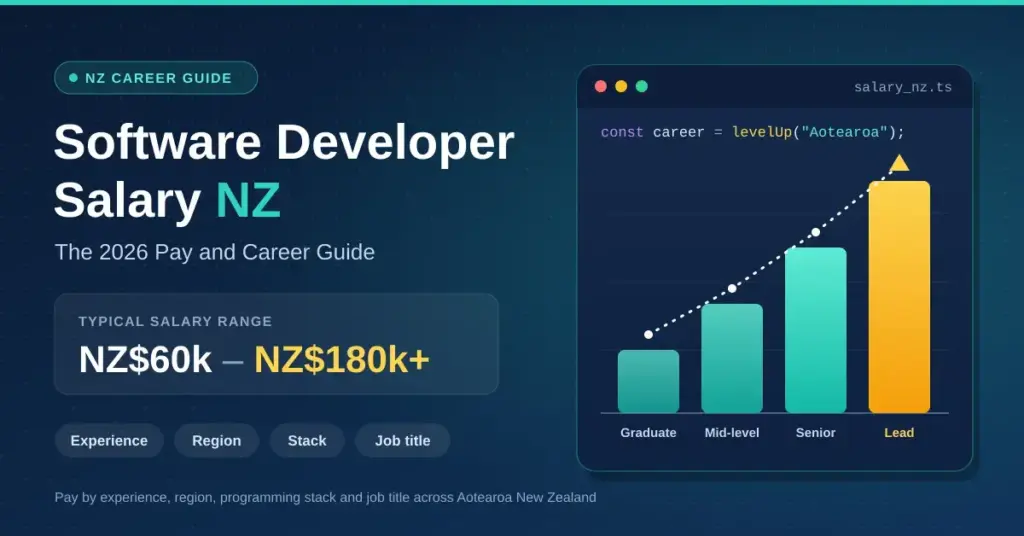
“Software developer salary” is one of the most-searched career questions in New Zealand, yet the honest answer is “it depends” — and it depends on which source you read. Published 2026 figures for the same job title range from roughly NZ$60,000 for a first role to well beyond NZ$180,000 for senior technical leaders. This guide gathers the current, verifiable numbers from SEEK, Payscale, Glassdoor and Levels.fyi, explains why they disagree, and breaks pay down by experience, region, programming stack and job title so you can benchmark a realistic figure for your own situation in Aotearoa.
Key Facts
- Typical range (SEEK, employer-disclosed): NZ$90,000 – NZ$110,000 for a general software developer.
- Industry averages (SEEK): around NZ$117,451 in ICT and NZ$124,375 in Engineering.
- First job / graduate: commonly NZ$60,000 – NZ$80,000.
- Senior & lead: roughly NZ$130,000 to NZ$180,000+ for the most experienced roles.
- Biggest levers: commercial experience, specialisation (cloud, security, data/AI) and city.
- Immigration: Developer Programmer and Software Engineer are Tier 1 Green List (Straight to Residence) roles.
What a Software Developer Earns in New Zealand
SEEK, which bases its figures on salaries that employers actually disclose in job advertisements, puts the typical software developer pay band at roughly NZ$90,000 to NZ$110,000 a year. Broken down by industry, SEEK reports averages of about NZ$117,451 in Information & Communication Technology and around NZ$124,375 in Engineering, with government roles sitting lower at close to NZ$99,000.
Self-reported databases land lower because of how they collect data: Payscale shows an average near NZ$78,955 and Glassdoor around NZ$88,000. These platforms skew toward base pay and often toward earlier-career respondents, so they understate senior and total-compensation figures. At the other end, Levels.fyi — which captures total compensation including bonuses and equity, weighted to senior and larger-employer roles — reports a senior median closer to NZ$135,000.
A sensible mid-point for a general, mid-level developer in 2026 sits around NZ$95,000 to NZ$105,000. On a standard 40-hour week that is roughly NZ$45 to NZ$50 an hour. Understanding the fundamentals of what a programmer does helps explain the spread: the title covers everyone from a graduate fixing bugs to an architect designing nationwide systems.
Salary by source
| Source | Reported figure (2026) | What it measures |
|---|---|---|
| SEEK (NZ) | ~NZ$90,000–NZ$110,000 typical; ICT average ~NZ$117,451 | Salaries disclosed by employers in job ads |
| Payscale | ~NZ$78,955 average | Self-reported base pay, often earlier-career respondents |
| Glassdoor | ~NZ$88,000 average | Self-reported estimates and employee submissions |
| Levels.fyi | ~NZ$135,000 median (senior total) | Total compensation, weighted to senior and larger-employer roles |
Why the Numbers Vary So Much
Before you anchor on any single figure, it helps to know why estimates differ by tens of thousands of dollars:
- Job-ad data versus self-reports: SEEK reads advertised ranges; Payscale and Glassdoor rely on individuals submitting their own pay.
- Superannuation and benefits: some quoted salaries include KiwiSaver contributions or bonuses, others do not.
- Seniority mix: a sample heavy with juniors pulls the average down, while a senior-weighted sample pushes it up.
- Sample size and recency: smaller or older datasets produce noisier averages.
The practical takeaway is to treat any single “average” with caution and compare several sources — which is exactly what the table above is for.
Salary by Experience Level
Experience is the single biggest driver of pay. The steepest jump usually comes when a developer moves from intermediate to senior, where commercial judgement and system ownership start to command a premium. The ranges below are indicative bands drawn from the sources cited at the end of this guide.
| Experience level | Years | Indicative range (2026) | Typical focus |
|---|---|---|---|
| Graduate / Junior | 0–2 | NZ$60,000 – NZ$80,000 | Bug fixes, building components, learning the team’s stack |
| Intermediate | 3–6 | NZ$85,000 – NZ$110,000 | Owning features, code review, mentoring juniors |
| Senior | 7+ | NZ$110,000 – NZ$150,000 | Architecture, technical decisions, cross-team delivery |
| Lead / Principal | 8+ with leadership | NZ$140,000 – NZ$180,000+ | System-wide design, strategy, people leadership |
Getting Your First Developer Job
Your first role tends to set the trajectory for the years that follow. SEEK data suggests a junior average near NZ$63,000, though graduate salaries in busier hubs and well-funded firms often start higher, in the NZ$70,000s. Candidates who arrive with a strong portfolio, an internship on their CV, or a recognised cloud certification (such as AWS or Microsoft Azure fundamentals) generally negotiate at the upper end of the junior band from day one.
Where You Work: Regions and Remote Roles
Location still shapes pay, largely because it tracks the concentration of large employers and the local cost of living. Auckland and Wellington remain the biggest markets by volume of advertised roles, with Wellington’s strong public-sector and GovTech demand and Auckland’s large private-sector and startup base.
- Auckland: the largest market; SEEK’s software engineer data shows Auckland Central averaging around NZ$118,750.
- Wellington: deep government, fintech and cybersecurity demand keeps senior pay competitive with Auckland.
- Christchurch: a growing centre for aerospace, agritech and electronics software.
- Regional centres (Hamilton, Tauranga, Dunedin): SEEK’s disclosed ranges show some regional averages reaching around NZ$110,000, narrowing the old city–region gap.
The Rise of Remote and Hybrid Work
Remote-first and hybrid arrangements are now common, letting developers in lower-cost regions work for Auckland-, Wellington- or Sydney-based employers. That can mean city-level pay with regional living costs, though remote roles are also more competitive and increasingly benchmarked to national rather than local rates. Whatever the setup, a reliable connection and sound security habits matter — including using a VPN when working from cafes or shared networks.
Skills and Specialisations That Lift Pay
Not all skills are valued equally. Performance-critical, security-sensitive and data/AI work tends to pay more than general web development, and the languages below reflect where New Zealand demand currently sits. Rather than invent a fixed percentage premium, it is more accurate to say certain stacks consistently command higher offers.
| Technology / stack | Where it is used in NZ | Demand notes |
|---|---|---|
| JavaScript / TypeScript | Web and full-stack, SaaS products | Consistently the most-requested skill set |
| Python | Data, AI/ML, automation, scripting | Fast-growing, especially in data and AI teams |
| C# / .NET | Enterprise, government, finance | Very common across established NZ organisations |
| Java | Banking and large back-end systems | Steady enterprise demand |
| Go / Rust | Cloud-native, performance and security | Niche but often premium-paying |
| SQL | Databases (cross-cutting) | A near-universal requirement rather than a specialism |
Why Full-Stack Developers Are in Demand
Full-stack developers — comfortable across both front-end and back-end — are prized by New Zealand’s many small and medium enterprises because one hire can cover work that would otherwise need two specialists. That versatility tends to attract offers at the higher end of the mid-level band, particularly in fast-moving startup environments.
The Value of Cloud, Security and Data Skills
With major cloud regions now operating in New Zealand, developers who understand deployment, data sovereignty and secure design are in strong demand. Familiarity with cloud computing platforms, sound cyber security practice, and the obligations of the Privacy Act 2020 is especially valued for financial and government projects where data protection is a board-level concern.
Developer, Engineer and the Roles Nearby
“Software Developer” overlaps with several related titles, and moving between them is a common way to lift pay. The indicative ranges below help you see where a role sits relative to your own.
| Role | Indicative NZ range (2026) | Typical scope |
|---|---|---|
| Software Developer | NZ$90,000 – NZ$120,000 | Builds and maintains applications |
| Software Engineer | NZ$100,000 – NZ$130,000 | Often broader system and architecture scope |
| Solutions / Software Architect | NZ$130,000 – NZ$180,000 | System design and technical leadership |
| DevOps Engineer | NZ$110,000 – NZ$150,000 | CI/CD, automation and cloud infrastructure |
| Data Engineer | NZ$110,000 – NZ$150,000 | Data pipelines and platforms |
| QA / Test Engineer | NZ$80,000 – NZ$110,000 | Testing and test automation |
| Engineering / Team Lead | NZ$140,000 – NZ$190,000 | Combined people and technical leadership |
Developer Versus Engineer: Is There a Real Difference?
The titles are frequently used interchangeably in New Zealand job ads, and the pay overlaps heavily — SEEK’s industry averages for the two are within a few thousand dollars of each other. Where a difference exists, “engineer” tends to imply a broader remit around system architecture, formal methods and integration, while “developer” can lean toward application feature work. It is worth reading the responsibilities in each ad rather than assuming the title alone dictates the salary. For a deeper look, see our guide to software engineer salaries.
Beyond Base Salary: Bonuses and Benefits
In 2026 the total package often matters as much as the headline number. New Zealand tech employers increasingly compete on flexibility and wellbeing as well as pay:
- Flexible work: hybrid models (a mix of office and home days) are now a standard expectation in the main centres.
- Health cover: subsidised medical insurance is a common inclusion, though not universal.
- Learning budgets: many contracts include an annual allowance for certifications and conferences.
- Equity: high-growth startups may offer share options (ESOPs), which carry upside but also risk and should be valued carefully.
- Bonuses: performance or profit-share bonuses exist but vary widely by employer and sector, so treat any single “average bonus” figure with scepticism.
Immigration, the Green List and Overseas Developers
Software development remains on New Zealand’s Green List, which offers streamlined residence pathways for qualified people. According to Immigration New Zealand, roles including Developer Programmer (ANZSCO 261312) and Software Engineer (261313) sit in Tier 1 — the Straight to Residence pathway.
- Pathway: Tier 1 lets eligible applicants apply for residence directly, from within New Zealand or offshore.
- Job offer: you generally need a full-time role (usually at least 30 hours a week) with an accredited employer.
- Qualifications: overseas qualifications must be comparable to the required New Zealand standard, which can mean assessment by the New Zealand Qualifications Authority.
- Remuneration: pay must meet Immigration New Zealand’s requirements, which are updated periodically — always check the current rules on the official site before applying.
Tips for International Job Seekers
To position yourself well, focus on credentials recognised in New Zealand, such as AWS or Microsoft Azure certifications, and build a public portfolio employers can inspect. Local references and networking carry real weight here, so applying to advertised software engineering jobs and connecting with accredited employers early can shorten the path considerably.
The Outlook for Developer Pay
Long-range salary forecasts should be read as informed guesses, not guarantees. That said, the underlying drivers point to steady rather than explosive growth: ongoing digital transformation across agriculture, manufacturing and government, a persistent shortage of experienced engineers, and the maturing of local cloud infrastructure. Demand is strongest for senior, security- and data-literate developers, where the skills shortage is most acute.
How AI Is Changing the Developer Role
AI coding tools are reshaping day-to-day work rather than replacing developers. The clearest effect is a shift in what commands a premium: away from raw code output and toward judgement — designing systems, reviewing and integrating AI-generated code, and governing how autonomous tools are used safely. Developers who learn to orchestrate these tools while keeping quality and security high are best placed to move up the salary bands.
How to Benchmark and Lift Your Salary
The software developer salary nz picture in 2026 is healthy but genuinely wide, so benchmark against several sources rather than one headline number, and adjust for your experience, city and specialisation. The clearest routes to higher pay are gaining commercial experience, deepening a valued specialism such as cloud, security or data, and moving toward roles with more architectural or leadership scope. For newcomers and migrants alike, the fastest gains come from building a demonstrable track record and networking within New Zealand’s main tech hubs.
Reference sources
Frequently Asked Questions (FAQ)
What is the average software developer salary in New Zealand in 2026?
It depends on the source. SEEK’s employer-disclosed data points to a typical band of about NZ$90,000 to NZ$110,000, with ICT-industry averages near NZ$117,451. Self-reported sites such as Payscale and Glassdoor report lower averages (roughly NZ$79,000 to NZ$88,000) because they skew toward base pay and earlier-career respondents. A realistic mid-level figure sits around NZ$95,000 to NZ$105,000.
How much do junior or graduate developers earn in NZ?
Entry-level and graduate developers commonly earn between NZ$60,000 and NZ$80,000. SEEK data suggests a junior average near NZ$63,000, while stronger candidates in busy hubs or with a cloud certification often start in the NZ$70,000s.
Do software developers earn more than software engineers in New Zealand?
Not by much. The titles overlap heavily and SEEK’s industry averages for the two are within a few thousand dollars. Where a difference exists, an “engineer” title can imply broader architectural responsibility, but you should read each job’s actual duties rather than rely on the title.
Which skills increase a developer’s salary the most?
Cloud platforms, security, and data or AI work tend to pay best, alongside high-demand languages such as JavaScript/TypeScript, Python and C#/.NET. Full-stack versatility and recognised certifications also help you negotiate at the top of your band.
Is software development still on New Zealand’s Green List?
Yes. Immigration New Zealand lists Developer Programmer and Software Engineer as Tier 1 roles on the Green List, offering a Straight to Residence pathway for people with a qualifying job offer from an accredited employer and a recognised qualification. Always confirm current requirements on the official Immigration New Zealand website.
Can I earn an Auckland salary while working remotely?
Sometimes. Remote and hybrid roles are common, and some employers pay national rather than local rates, which can mean higher pay for developers based in lower-cost regions. However, remote roles are competitive, and an increasing number are benchmarked to a national rather than a city-specific salary.


