
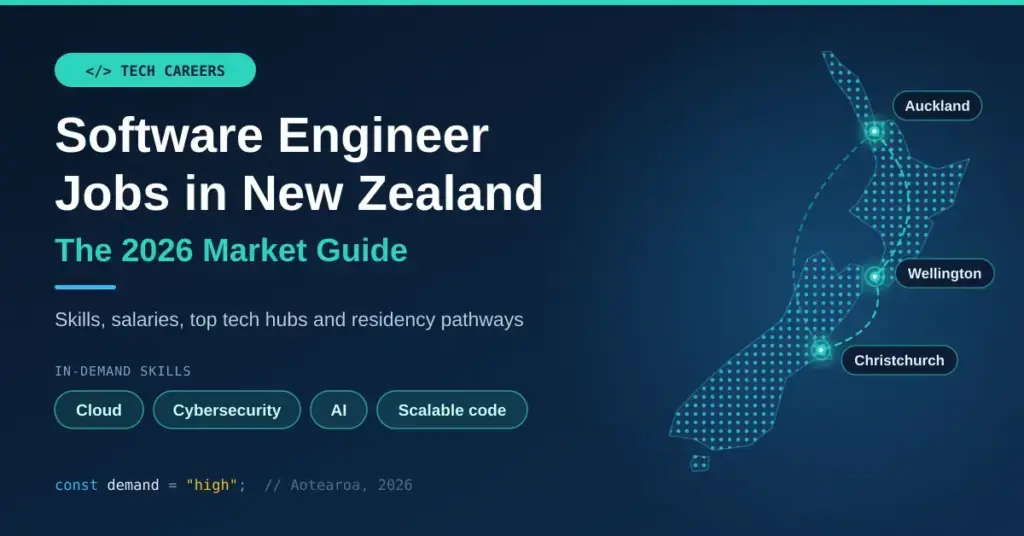
New Zealand’s technology sector has become one of the country’s most active job markets, and demand for engineers who can build, secure and scale software shows little sign of slowing. Digital tech is now among Aotearoa’s largest export earners, and employers in Auckland, Wellington and Christchurch are competing for people who can pair solid coding skills with cloud, security and AI knowledge. This guide explains what the market looks like in 2026, what skills and qualifications employers value, what the pay actually is, where the jobs are, and how migrants can move here through the residency system — with figures checked against public salary and immigration data rather than hype.
Key Points
- Strong demand: software and ICT roles remain among New Zealand’s most sought-after, with recruiters reporting ongoing shortages in cybersecurity, cloud and AI.
- Typical pay: SEEK advertises many engineering roles around NZ$100,000–NZ$120,000; senior and architecture roles often exceed NZ$150,000.
- Top hubs: Auckland (fintech and enterprise), Wellington (government and security) and fast-growing Christchurch.
- Residency: several software roles are Tier 1 on the Green List, offering a Straight to Residence pathway — confirm current rules with Immigration New Zealand.
- Skills that pay: JavaScript, Python, Go and Rust, plus cloud (AWS/Azure), security and AI integration.
What the 2026 tech job market looks like
The New Zealand market in 2026 is shaped by two forces: the spread of AI-assisted development and a push to keep sensitive data inside the country. Generative AI tools have taken over a lot of routine coding, but they have also created work for engineers who can design, review and safely deploy AI features rather than simply write functions by hand. At the same time, the “sovereign cloud” idea — keeping government and health data under New Zealand jurisdiction — has kept demand high for people who understand infrastructure, hosting and compliance.
Recruiters consistently report that qualified developers are hard to find, especially in higher-demand areas. The strongest current themes include:
- AI-assisted development: familiarity with AI coding assistants and large language model (LLM) integration — connecting apps to models like those from OpenAI or Anthropic — is increasingly listed as a “nice to have” and, in some teams, a core requirement.
- Cloud and platform engineering: steady demand for people who can run workloads across AWS, Microsoft Azure and Google Cloud, and automate deployment.
- Cybersecurity: a shift from reactive defence to proactive threat hunting, which keeps cybersecurity and DevSecOps roles (developers who build security into the delivery pipeline) among the most sought-after.
- Sustainable and efficient software: energy-aware design is increasingly written into public-sector and enterprise briefs.
The role of referrals and the “hidden” market
A large share of software roles are filled through referrals, internal moves and direct approaches rather than public adverts. Industry surveys have long suggested that a significant portion of vacancies never reach the big job boards, so relying only on SEEK or LinkedIn can mean missing openings. For job seekers, an active GitHub profile, a public portfolio and attendance at local meetups in Auckland or Wellington can matter as much as a polished CV, because they make you visible to the people doing the hiring.
Technical skills and programming languages in demand
No single language guarantees a job, but employer adverts and salary data point to a clear cluster of in-demand skills. JavaScript and Python remain the backbone of web and data work, while Go and Rust are growing for performance-sensitive systems and cloud services. Employers increasingly value “polyglot” engineers who can move between stacks and understand how the pieces fit together, alongside a working knowledge of cloud computing and automated deployment.
| Skill area | Commonly requested technologies | Where it is used |
|---|---|---|
| Backend | Go, Rust, Node.js, Java, C# | High-performance APIs and cloud services |
| Frontend | React, Vue.js, TypeScript | Modern SaaS products and mobile-responsive apps |
| Data and AI | Python, SQL, PyTorch, TensorFlow | Fintech, agritech and analytics |
| Infrastructure | Kubernetes, Terraform, AWS, Azure | Cloud platforms and hosting for local data |
The rise of AI-focused engineering
A newer specialisation has grown around building software that uses AI models to plan and carry out multi-step tasks, sometimes called AI or “agentic” engineering. These roles combine ordinary software skills with prompt design, testing and guardrails so that automated systems behave predictably. In Wellington in particular, this work often intersects with public-sector projects, where privacy rules and Māori data governance set firm limits on how information can be used.
Salary expectations in 2026
Pay depends heavily on experience, specialisation and location, and different data sources measure it differently. Figures advertised by employers on job boards tend to sit higher than self-reported survey averages, so it helps to compare a few sources. According to SEEK, software engineering roles are commonly advertised in the range of roughly NZ$100,000 to NZ$120,000, and the information and communication technology (ICT) sector as a whole averages around NZ$115,000. Self-reported platforms such as Payscale and Glassdoor report lower averages, closer to NZ$80,000–NZ$90,000, because they include a wider mix of junior and part-time respondents.
As a general guide by experience level:
- Junior (0–2 years): roughly NZ$60,000 to NZ$80,000, with stronger graduates starting higher.
- Intermediate (3–6 years): roughly NZ$85,000 to NZ$110,000.
- Senior (7+ years): roughly NZ$110,000 to NZ$150,000.
- Lead or principal: often NZ$140,000 to NZ$180,000 and above, especially in security or architecture.
Total packages frequently add benefits such as flexible or hybrid work, health insurance, professional-development budgets and, at some high-growth firms, share options. For a deeper breakdown by role and region, see our guide to software developer salaries in New Zealand.
How location affects pay
Auckland tends to advertise the highest base salaries — SEEK data points to advertised averages near NZ$118,000 for engineering roles — which partly offsets its higher living costs. Wellington sits close behind, supported by stable government and SaaS work. Christchurch is often described as a value option: pay is competitive and typically a little lower than Auckland, but housing and day-to-day costs are usually cheaper, which can leave more in your pocket. Remote and hybrid arrangements have also narrowed some of these gaps for people living outside the main centres.
Regional hotspots for software engineering
New Zealand is small, but its tech hubs have distinct characters. Where you choose to work can come down to whether you prefer fast-moving fintech, mission-driven public-sector projects or a lower cost of living.
- Auckland: the largest concentration of fintech, e-commerce and enterprise software, and home to major employers including Xero.
- Wellington: a centre for government technology, cybersecurity and screen/creative tech, with a strong focus on data privacy.
- Christchurch: a fast-growing hub with hundreds of current software vacancies, strengths in aerospace, geospatial and primary-industry software, and an ongoing shortage of experienced developers.
- Dunedin: nicknamed “Gigatown” for its early high-speed fibre, with a startup scene linked to the University of Otago.
Why Christchurch is worth a look
Christchurch has rebuilt itself into a credible tech centre, with employers hiring across fleet management, telematics, geospatial analysis and software for primary industries. Recruiters regularly describe the city as short of experienced engineers, and roles there can offer the chance to work on specialised systems while living close to the Southern Alps. For candidates weighing lifestyle against salary, it is often the most affordable of the main hubs.
Immigration and residency pathways
Software engineering remains one of the most reliable routes to New Zealand residency for skilled migrants. Several software and ICT occupations sit in Tier 1 of the Green List, which offers a “Straight to Residence” pathway — meaning you can apply for residence directly, from onshore or offshore, without first spending years in the country. Because the rules change from time to time, always confirm the current criteria on the official Immigration New Zealand website before applying.
In broad terms, the main options are:
| Pathway | Typical requirements (confirm current rules) | Who it suits |
|---|---|---|
| Green List – Straight to Residence | A job or job offer from an accredited employer in a listed role, a relevant qualification or recognised experience, pay at the applicable threshold, and meeting age and health/character rules. | Software engineers, AI specialists and security architects. |
| Skilled Migrant Category | A points-based residence pathway that rewards skilled employment, qualifications and experience for people already working, or with an offer, in New Zealand. | Experienced professionals building a record in New Zealand. |
| Accredited Employer Work Visa (AEWV) | A temporary work visa tied to an accredited employer; from March 2025 the set median-wage requirement was removed, though employers must still pay the market rate for the role. | Those coming to work first and moving to residence later. |
A quicker route for graduates of NZ institutions
Recent policy has favoured migrants who study in New Zealand, with shorter work-experience requirements for some graduates of local universities than for those applying entirely from offshore. The aim is to encourage international students to stay and contribute after finishing their degrees. As with all immigration settings, the details shift, so treat any timeline as indicative and verify it against official guidance.
Where the jobs are advertised
Finding work in 2026 usually means using several channels at once. Traditional boards remain useful, but direct approaches and specialist recruiters are often more effective for mid- to senior-level roles.
- SEEK: the largest job board in New Zealand, with detailed tech filters and saved-search alerts.
- LinkedIn: strong for real-time postings and for networking directly with hiring managers.
- Trade Me Jobs: popular with local small and medium businesses, and sometimes lists roles not seen elsewhere.
- Company career pages: employers such as Xero, Datacom and Orion Health often post roles directly.
- Specialist recruiters and communities: tech-focused agencies, plus GitHub and local tech communities, are common ways startups find candidates.
What specialist recruiters add
Recruiters who focus on technology can be valuable for candidates targeting startups or enterprise cloud teams. They often know about roles that are not publicly advertised and can explain a company’s culture, technical debt and roadmap in ways a job description cannot. Treat them as one part of your search rather than the whole of it, and keep applying directly as well.
Education and qualifications
New Zealand employers value both formal study and practical, industry-recognised credentials. A large share of engineers hold a bachelor’s degree, but the growth of shorter “micro-credentials” and diplomas has opened the field to career-changers. Common routes include:
- Bachelor of Engineering (Honours) in Software Engineering: a four-year accredited degree suited to complex systems work.
- Diplomas in software development: shorter, practical programmes focused on full-stack web and mobile development.
- Cloud certifications: credentials such as AWS Solutions Architect and Microsoft Azure Fundamentals are widely requested for intermediate roles.
- Security certifications: qualifications like CISSP and CEH help for roles in security operations.
Learning while you work
Many tertiary providers now build real project experience into their courses, partnering with employers so students graduate with hands-on work behind them. This “work-integrated learning” shortens onboarding for employers and gives graduates a portfolio to show, which is especially useful in a competitive entry-level market.
The highest-paying tech roles
The best-paid technology roles in New Zealand cluster around cybersecurity and architecture, where deep technical skill meets strategy and governance. According to 2025–26 salary guides from recruiters such as Hays and Talent International, senior specialists in these areas routinely earn well above NZ$190,000 in total compensation, with the very top roles higher again. The table below shows indicative figures — actual pay varies by employer, sector and individual experience.
Highest-Paying Tech Roles
| Role | Indicative total pay (NZ$) | Focus |
|---|---|---|
| Cybersecurity Architect | ~225,000 | Designing secure systems and defences |
| Enterprise Architect | ~195,000–215,000 | Aligning technology with business strategy |
| Technical Architect | ~165,000–200,000 | System-wide technical design |
| Technology Programme Manager | ~200,000 | Leading large delivery programmes |
| Cybersecurity Manager | ~200,000 | Running security operations and teams |
| Data & AI Manager | ~195,000 | Leading data and AI initiatives |
| AI Solutions Architect | ~195,000 | Designing AI-driven products and platforms |
Indicative figures from 2025–26 New Zealand salary guides; actual pay varies by employer, sector and experience.
Looking ahead: what comes next
Toward the late 2020s, the next wave of roles is likely to grow around edge computing, the Internet of Things and early quantum-readiness. Continued investment in ultra-fast fibre — the same national fibre and cable infrastructure that underpins New Zealand’s internet — supports low-latency applications that process data on devices rather than in distant data centres. Areas to watch include:
- Post-quantum security: demand for developers who can build systems resilient to future quantum-era decryption.
- Internet of Things: software for smart infrastructure, precision agriculture and logistics.
- Data governance: roles that apply the Privacy Act and Māori data-sovereignty principles, treating data as taonga (a treasured resource).
Is a software engineering career in New Zealand worth it?
For skilled engineers, New Zealand offers a rare mix of challenging work, competitive pay and a lifestyle that many rate highly. The bar has risen — AI and cloud have raised expectations and thinned out some routine junior work — but that has also made capable, adaptable engineers more valuable. Focusing on strong fundamentals, a couple of in-demand specialisations, cloud fluency and a visible presence in the local community remains the most reliable way to build a durable career here, whether you are a local graduate or a migrant planning to settle.
Sources
- SEEK — Software Engineer salary in New Zealand
- Immigration New Zealand — Green List occupations
- Immigration New Zealand — Changes to the AEWV and median wage
- TIN Report 2025 — New Zealand technology export figures
- Talent International — Highest paying tech jobs in New Zealand
- Hays New Zealand — The highest paying IT jobs
Frequently asked questions
What is the average salary for a software engineer in New Zealand in 2026?
It depends on the source and the level. SEEK data shows software engineering roles commonly advertised around NZ$100,000 to NZ$120,000, and the ICT sector averaging near NZ$115,000. Self-reported surveys can be lower, while senior and architecture roles run well above NZ$150,000.
Is software engineering on New Zealand’s Green List?
Yes. Several software and ICT occupations sit in Tier 1 of the Green List, which offers a Straight to Residence pathway for people with a job or offer from an accredited employer who meet the qualification, pay and age criteria. Always check the current rules on Immigration New Zealand’s website.
Which New Zealand city has the most software engineering jobs?
Auckland has the largest number of roles and the biggest fintech and enterprise scene, followed by Wellington. Christchurch is growing quickly and is frequently short of experienced developers, making it a strong option for candidates who want lower living costs.
Do I need a degree to work as a software engineer in New Zealand?
Not always. Many engineers hold a bachelor’s degree, but practical experience, a solid portfolio and industry certifications such as AWS or Azure credentials are increasingly accepted by employers, and diplomas or micro-credentials can open the door for career-changers.
Which programming languages are most in demand in New Zealand?
JavaScript and Python are the most widely used, with TypeScript common on the frontend. Go and Rust are growing for performance-focused and cloud services, and SQL remains essential for data work. Being comfortable across more than one stack is a clear advantage.