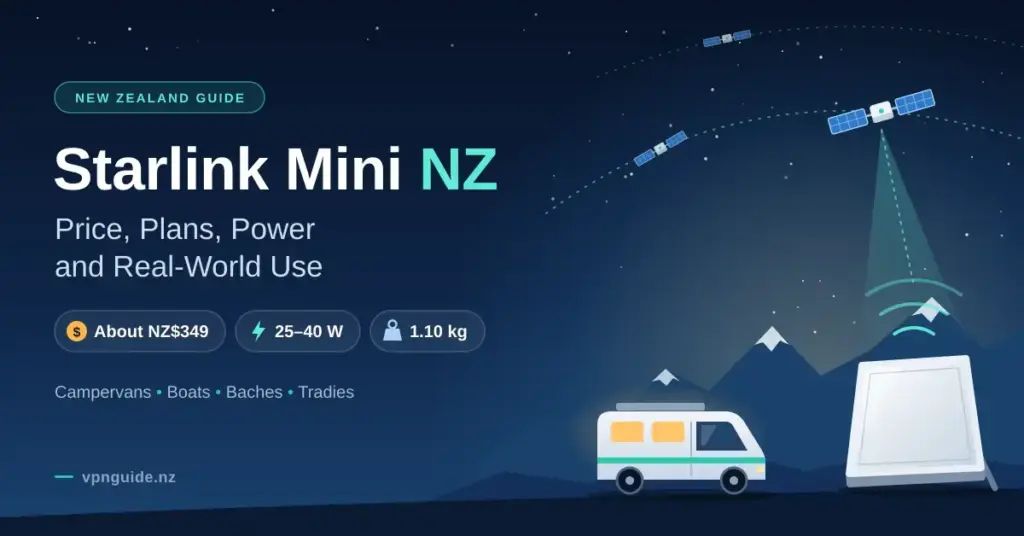
The Starlink Mini is the compact, backpack-sized member of the Starlink satellite internet family. It folds the dish (the flat panel that talks to SpaceX’s low-Earth-orbit satellites) and the Wi-Fi router into a single slab about the size of a 15-inch laptop, and it draws little enough power to run from a car socket or a large USB-C power bank. In New Zealand the hardware sells for roughly NZ$349 as a one-off purchase, plus a monthly plan on top. It is built for people who need a connection away from a fixed address: campervans and boats, tradies moving between job sites, remote baches and holiday homes, field research, and anyone who wants a portable backup for when fibre or mobile data drops out.
Quick facts
| Product | Starlink Mini (portable satellite dish with built-in Wi-Fi router) |
| Made by | Starlink / SpaceX |
| NZ hardware price | About NZ$349 (one-off) |
| Best-fit plan | Roam 100GB (NZ$100/mo) or Roam Unlimited (NZ$235/mo) |
| Weight | 1.10 kg (1.16 kg with kickstand) |
| Power | 25–40 W; 12–48 V DC or 100 W USB-C |
| Wi-Fi | Built-in Wi-Fi 5, up to ~112 m², up to 128 devices |
| Weatherproofing | IP67; −30 °C to 50 °C |
| Best for | Campervans, boats, remote sites, baches, backup internet |
What the Starlink Mini actually is
Starlink is the satellite broadband service run by SpaceX. Instead of a single dish pointed at one distant satellite in a fixed orbit, it uses a large fleet of satellites in low Earth orbit — a few hundred kilometres up rather than tens of thousands — which is why its latency (the delay before data starts moving) is far lower than the old satellite internet many rural New Zealanders remember. You can read more background on the Starlink satellite network if you want the full history.
The Mini is simply the smallest, most portable dish in the range. Where the Standard kit is a larger panel with a separate Gen 3 router, the Mini packs a smaller antenna and a dual-band Wi-Fi router into one unit. That trade — a little less raw performance in exchange for portability, low power draw and a single box to carry — is the whole point of the product. If you want a fixed connection for a rural house, our full Starlink NZ broadband guide covers that setup; this page focuses on the Mini and the moving-around use cases it was designed for.
Starlink Mini specifications
The figures below come from Starlink’s published Mini specification sheet and match the details listed by New Zealand retailers such as JB Hi-Fi and PB Tech.
| Specification | Starlink Mini |
|---|---|
| Size | 298.5 × 259 × 38.5 mm (about the footprint of a 15-inch laptop) |
| Weight | 1.10 kg (1.16 kg with the built-in kickstand) |
| Power draw | 25–40 W on average |
| Power input | 12–48 V DC at 60 W, or USB-C Power Delivery at 100 W (20 V / 5 A) using Starlink’s USB-C cable accessory |
| Wi-Fi | Built-in Wi-Fi 5 (802.11ac), dual-band, coverage up to about 112 m², up to 128 devices |
| Weather rating | IP67 with the DC power cable and plug fitted (dust-tight and protected against short immersion) |
| Operating temperature | −30 °C to 50 °C |
| Field of view | 110° |
| NZ retail price | About NZ$349 (one-off hardware cost) |
Mini or the Standard kit?
The Standard kit costs about NZ$599 in New Zealand and is designed to be bolted to a roof or mounted in one spot and left there. The Mini costs less up front, is far easier to move, and runs on low-voltage power — but its smaller antenna means it is a little slower and more sensitive to where you put it. The table below sums up the trade-off.
| Feature | Starlink Mini | Standard kit |
|---|---|---|
| NZ price (hardware) | About NZ$349 | About NZ$599 |
| Form factor | One laptop-sized unit, router built in | Larger dish plus a separate Gen 3 router |
| Weight | 1.10 kg | Considerably heavier |
| Power | Runs on 12–48 V DC or a 100 W USB-C power bank | Designed for mains power at a fixed site |
| Best for | Travel, vehicles, boats, temporary sites, backup | A permanent home or business connection |
| Performance | Slightly lower, more placement-sensitive | Higher and steadier |
Key points
- The Mini is about NZ$349 as a one-off, plus a monthly plan; the Standard kit is about NZ$599.
- The Wi-Fi router is built in — no separate box and no extra cabling to carry.
- Low power draw (25–40 W) lets it run from a 12–48 V vehicle system or a 100 W USB-C power bank.
- Roam is the plan for a unit that moves; Residential is cheaper but locked to one address.
- A clear view of the sky matters most — always run the app’s obstruction check before you settle on a spot.
- For a permanent rural home, the Standard kit on a Residential plan is usually the steadier choice.
Plans that work with the Mini in New Zealand
Buying the hardware is only half the cost — you also choose a monthly plan. Starlink splits its plans into Roam (for use away from a registered home address, including on the move) and Residential (tied to one fixed address). The Mini works on either, but Roam is the natural fit for a unit that travels. Prices below were confirmed against Starlink’s New Zealand service plans and NZ broadband comparison listings in September 2026.
| Plan | Price / month | Typical download | Data |
|---|---|---|---|
| Roam 100GB | NZ$100 | Up to ~260 Mbps | 100 GB at full speed, then slower unlimited |
| Roam Unlimited | NZ$235 | Up to ~400 Mbps | Unlimited |
| Residential 100 Mbps | NZ$85 | ~100 Mbps | Unlimited (fixed address) |
| Residential 200 Mbps | NZ$125 | ~200 Mbps | Unlimited (fixed address) |
| Residential Max | NZ$170 | Up to ~400 Mbps | Unlimited, top network priority |
Starlink usually offers a 30-day trial and charges no connection fee, no contract and no early-termination fee, so you can test the service and cancel if a spot does not work out. Prices change often and can rise mid-year, so confirm the current figure before you order. If you are weighing satellite against a fixed line, our rundown of New Zealand internet providers puts the options side by side.
Which plan suits the Mini?
For a campervan, boat or anything else that moves, choose a Roam plan — Residential is locked to a single address and will not follow you around the country. Roam 100GB (NZ$100) is enough for browsing, email, maps and modest streaming on a weekend away; the 100 GB is at full speed, after which the connection keeps working at a reduced rate. Roam Unlimited (NZ$235) makes sense for people who live on the road or run a business from remote sites. If the Mini will mostly sit at one address — say a bach you visit often — a Residential plan is cheaper per month, but you lose the freedom to move it.
Setting up and using the Mini
Placement and the obstruction check
The single biggest factor in how well the Mini performs is a clear view of the sky. The dish tracks satellites as they pass overhead, so trees, cliffs, buildings and even a caravan awning can cause brief dropouts each time a satellite disappears behind them. Before you commit to a spot, open the Starlink app and run its built-in obstruction check: it uses your phone camera to scan the sky and warns you about blocked areas. A rooftop, an open paddock or a pole mount clear of the tree line will always beat a shaded corner.
Power: batteries, vehicles and power stations
Because the Mini draws only 25–40 W, it is genuinely practical to run off-grid — but the supply has to meet its requirements or the unit may not start. There are three common ways to power it:
- USB-C power bank: it needs one rated for 100 W output (20 V / 5 A) over USB-C Power Delivery, used with Starlink’s USB-C cable accessory. A 20,000 mAh bank runs the Mini for roughly two hours.
- Vehicle 12 V system: a 12–48 V DC input at 60 W suits a campervan, 4WD or boat with a suitable adapter, and handles much longer sessions.
- Portable power station: a battery station with a 100 W USB-C or DC output is the easiest way to run the Mini for a full day of work.
As a rough guide, expect the Mini to use somewhere around 0.6–1 kWh over a full day of steady use, so a 500 Wh or larger power station is a sensible pairing for camping.
Wi-Fi coverage and extending it
The built-in dual-band Wi-Fi 5 comfortably covers a campervan, boat cabin or small bach — roughly 112 m² and up to 128 devices. In a larger building or across a farmyard, walls and distance will thin the signal. The fix is the same as for any home network: add a mesh system or an extender that connects back to the Mini. Our mesh Wi-Fi guide explains how many units a space needs and where to place them, and the Wi-Fi extender guide covers the cheaper single-unit route.
Real-world speed and performance
New Zealand’s Commerce Commission independently measures broadband through its Measuring Broadband New Zealand reports, and those results show Starlink’s low-Earth-orbit service averaging well above 120 Mbps download at peak times on home plans, with latency typically in the 25–45 ms range — a world away from the old geostationary satellite services. Those figures come from fixed installations, though. A Mini on a campsite will usually run a little slower, and obstructions matter far more than the plan you are on. If you want to check the connection at a specific spot, our internet speed test works fine over Starlink.
Uploads sit around 35–40 Mbps depending on the plan, which is plenty for video calls, cloud backups and sharing large files from the field. Performance dips most during busy evening hours and in heavy rain or snow, when the signal has more to fight through.
Who the Starlink Mini is for
The Mini makes the most sense for people and situations that move or lack fixed coverage:
- Travellers and van-lifers who want a real connection in places mobile data cannot reach.
- Tradies and contractors running site offices where there is no line yet.
- Boaties and remote workers who need reliable uploads away from town.
- Bach and lifestyle-block owners who want internet for occasional stays without paying for a permanent line.
- Anyone wanting a backup for when fibre, VDSL or 4G fails during an outage.
It is a less obvious pick for a permanent rural home, where the Standard kit on a Residential plan gives more speed and steadier performance for a similar monthly cost. Satellite has become mainstream in rural New Zealand regardless of which dish you choose: the Commerce Commission’s rural connectivity update found Starlink held about 27 per cent of rural connections, making it the single largest rural provider in the country. If you are comparing satellite with cellular options, our wireless broadband guide looks at 4G and 5G alternatives.
Common mistakes to avoid
- Under-powering it. A generic USB-C charger or a low-output power bank will not start the Mini — it needs a true 100 W USB-C (20 V / 5 A) or a 12–48 V DC supply.
- Skipping the obstruction check. A shaded spot that seems fine at midday can drop out repeatedly as satellites pass behind trees.
- Buying the wrong plan. Residential will not travel; if the unit moves, you need Roam.
- Expecting Standard-kit speeds. The smaller antenna trades some performance for portability — that is by design.
- Forgetting data limits. Roam 100GB slows after the full-speed allowance is used, so heavy streamers may want Roam Unlimited.
Security and privacy on Starlink
The Mini is a normal internet connection, which means the usual home-network habits apply. Change the default Wi-Fi name and password in the Starlink app, keep the firmware updated (it updates automatically), and treat public-facing devices the way you would on any network. Because satellite routes traffic through Starlink’s ground stations, a VPN (a virtual private network, which encrypts your traffic and hides your location) still works normally over the Mini. If you use one, pick an Auckland server to keep the added latency low — our best VPN guide notes which providers run New Zealand servers.
Disclaimer
General information only. Specifications are taken from Starlink’s published specification sheet; prices, plans and data allowances are as listed by Starlink and New Zealand retailers in September 2026 and change frequently. Confirm current pricing and check Starlink’s terms before using the Mini on the move or on water.
Reference sources
Frequently asked questions
How much is Starlink Mini in NZ?
The Mini hardware costs about NZ$349 as a one-off purchase at New Zealand retailers such as PB Tech and JB Hi-Fi, plus a monthly plan on top. Prices vary a little between shops and over time, so check before you buy.
Which plan should I use with Starlink Mini?
For anything that moves, use a Roam plan — NZ$100 a month for 100 GB at full speed, or NZ$235 a month for unlimited data, as listed in September 2026. Residential plans are cheaper but are locked to one fixed address.
Can Starlink Mini run off a power bank?
Yes, if the power bank supplies 100 W over USB-C (20 V / 5 A) and you use Starlink’s USB-C cable accessory. A 20,000 mAh unit runs the Mini for roughly two hours; a vehicle 12 V system or a portable power station lasts much longer.
Does Starlink Mini need a separate router?
No. It has dual-band Wi-Fi 5 built in, covering about 112 m² and up to 128 devices. For a larger building you can add a mesh system or extender that connects back to the Mini.
Is Starlink Mini as fast as the standard dish?
Usually a little slower and more sensitive to placement, because of its smaller antenna. For a permanent home connection the Standard kit on a Residential plan is the steadier choice; for travel and backup, the Mini’s portability wins.