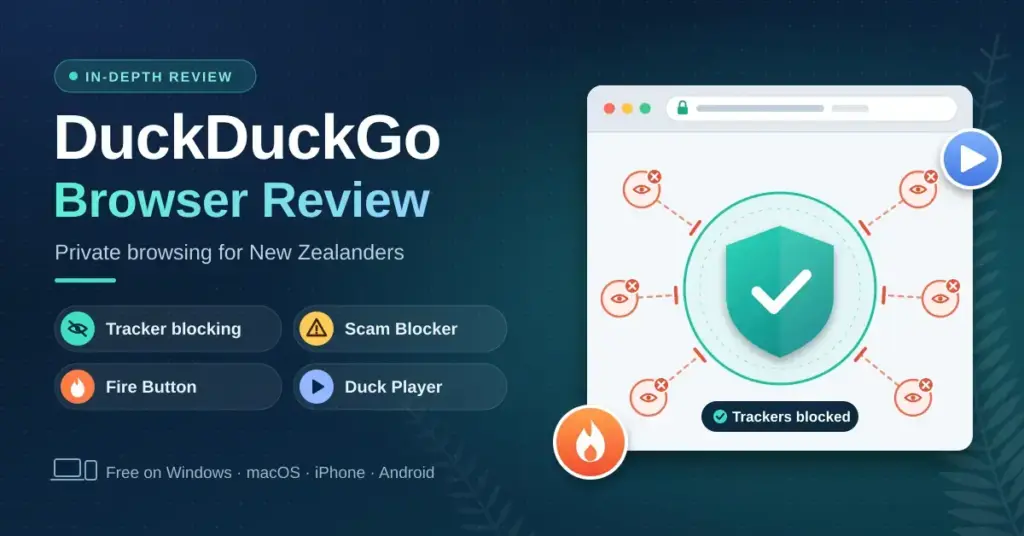
Every time you check a price, read the news, or log in to a service, dozens of hidden scripts try to record what you did and tie it back to you. A privacy-first browser aims to shut that down at the source rather than after the fact. This DuckDuckGo browser review looks at the free private browser built by the company behind the DuckDuckGo search engine, and at how it behaves for everyday use in Aotearoa New Zealand — from online banking and government logins to streaming, shopping and reading the news. If you are still weighing your options, our overview of secure browsers for New Zealanders puts DuckDuckGo in context alongside the main alternatives.
Key Points
- Free private browser for Windows, macOS, iPhone and Android from DuckDuckGo, Inc.
- Tracker blocking, Scam Blocker and HTTPS upgrading are on by default — no setup needed.
- The Fire Button clears your tabs, history, cookies and cache in one tap.
- Duck Player plays YouTube without targeted ads or feeding your watch-history profile.
- Email Protection gives a free @duck.com address that strips hidden email trackers.
- No extension or add-on support on any platform; Bitwarden integration is macOS-only.
- It is a privacy browser, not a VPN — it protects your browsing, not your whole connection.
What Is the DuckDuckGo Private Browser?
The DuckDuckGo Private Browser is a free web browser made by DuckDuckGo, Inc., the independent privacy company best known for its non-tracking search engine. It is available for Windows, macOS, iPhone and Android, and it arrives with privacy protections switched on by default — there is no long settings menu to configure and no bundle of third-party add-ons to install before it starts blocking trackers.
Under the hood, DuckDuckGo does not ship its own heavily modified copy of Chromium the way many rival browsers do. On Windows it uses Microsoft’s WebView2 component (which is built on the Chromium engine), while on Mac and iPhone it uses Apple’s WebKit engine, and on Android it uses the system WebView. Building on these native, operating-system-level components keeps the app relatively small and means the underlying engine receives security updates through your device rather than a separate download.
The apps are free, and DuckDuckGo has published much of its browser source code publicly — the custom code for its Android and iOS apps is released under the open Apache 2.0 licence, although the operating-system rendering components it sits on remain proprietary. The company says it funds the browser through privacy-respecting search advertising, not by collecting and selling your data.
How It Differs From Mainstream Browsers
The clearest way to understand DuckDuckGo is to compare its defaults with a typical mainstream browser. Where Chrome or Edge often treat tracking protection as something you add later, DuckDuckGo builds the main privacy tools into the core app.
| Feature | Typical mainstream browser | DuckDuckGo Private Browser |
|---|---|---|
| Tracker blocking | Limited, or depends on add-on extensions | Third-party tracker blocking on by default |
| Clearing your data | Buried in history and settings menus | One-tap Fire Button on the toolbar |
| Default search | Usually a tracking-based search engine | DuckDuckGo private search |
| Cookie pop-ups | Handled manually or via extensions | Cookie Pop-Up Manager can auto-decline where supported |
| Extensions / add-ons | Large add-on stores available | Not supported on any platform |
Core Features: Fire Button, Duck Player and Email Protection
A useful review has to look at the features people actually touch every day. DuckDuckGo’s most recognisable one is the Fire Button, which sits directly on the toolbar. A single click closes your tabs and burns your browsing history, cache and cookies for the current session, giving you a clean slate without digging through menus. You can set it to clear everything or exclude sites you have chosen to stay signed in to.
Quick Facts
| Developer | DuckDuckGo, Inc. |
| Official download | duckduckgo.com/app |
| Operating systems | Windows 10/11, macOS, iOS, Android |
| Price / licence | Free; app code largely open source (Apache 2.0) |
| File size | Small installer; varies by platform |
| Default search | DuckDuckGo private search |
Duck Player is a built-in way to watch YouTube in a cleaner window. It plays videos without targeted advertising and, importantly, keeps what you watch from feeding your YouTube recommendation profile. Once an option only on Mac, Duck Player is now available on the Windows browser as well.
Email Protection and Duck Addresses
For anyone tired of signing up for a service and then drowning in targeted mail, the built-in Email Protection tool is one of DuckDuckGo’s most practical additions. It gives you a free personal @duck.com address that forwards to your real inbox while stripping out the hidden tracking pixels advertisers use to see when and where you opened a message.
- Tracker removal: Hidden email trackers are scanned out before the message is forwarded to your normal inbox.
- Private Duck Addresses: You can generate unique, disposable addresses on the fly for individual sign-ups, then deactivate any that start leaking or spamming.
- Cookie Pop-Up Manager: Where a site supports it, DuckDuckGo can automatically dismiss cookie consent banners and choose more private options for you.
- Privacy dashboard: A small shield in the address bar shows how many tracking attempts were blocked on the page you are viewing.
Security and Safety: Is It Safe for Daily Use?
Handing your everyday browsing to a new app is a reasonable thing to be cautious about, so it is worth being clear: DuckDuckGo is a mainstream, well-reviewed browser that is safe for normal daily use. Because it renders pages with your operating system’s own engine components, it inherits the security patches those components receive, which helps keep it current against known web vulnerabilities.
Its protection also goes beyond blocking ads. The browser’s Smarter Encryption feature automatically upgrades connections from insecure HTTP to encrypted HTTPS wherever the destination site supports it, which matters most on shared or public Wi-Fi. This complements, rather than replaces, other safeguards — for a fuller picture of staying safe online locally, our cyber security guide for New Zealand is a good companion read.
Scam Blocker and Tracking Defences
In 2025 DuckDuckGo expanded its built-in Scam Blocker, which warns you before you load sites known for phishing, malware, fake online shops, bogus cryptocurrency exchanges and “scareware” that falsely claims your device is infected. Notably, Scam Blocker works from a threat feed supplied by the independent security firm Netcraft rather than relying on Google’s Safe Browsing, so it protects you without routing that data through Google.
- Third-party tracker blocking: Known advertising and analytics trackers are blocked before they load, across the sites you visit.
- Global Privacy Control (GPC): The browser can broadcast an opt-out “do not sell or share” signal that some jurisdictions treat as a legally recognised request.
- Fingerprinting defences: DuckDuckGo works to reduce the unique signals sites use to fingerprint your device.
- Cross-site tracking limits: Cookies and scripts are isolated so advertisers find it harder to follow you from site to site.
Performance on New Zealand Connections
For users across New Zealand, a browser is only as good as it feels on real connections — whether that is a fibre plan in Wellington or a mobile data connection while travelling through the regions. Because DuckDuckGo blocks many advertising and tracking scripts before they download, pages that are heavy with ads can load noticeably faster and use less of your data allowance, since those extra requests never happen.
The size of that benefit depends entirely on the sites you visit: an ad-light page will look much the same as it does elsewhere, while a page stuffed with trackers can feel considerably lighter. DuckDuckGo does not promise a fixed speed increase, and neither should any honest review — the gain comes from not downloading content you did not want in the first place. If tracker and ad control is your main goal, it is worth understanding how the options compare, which we cover in our guide to ad blockers in New Zealand.
Using It With New Zealand Banks and Services
A global privacy browser is only useful locally if it plays nicely with the sites Kiwis rely on. In practice DuckDuckGo works with mainstream New Zealand services the same way any modern browser does, because it renders standard web pages using native engine components.
- Online banking: Works with the major banks’ web portals, including ANZ, ASB, BNZ, Westpac NZ and Kiwibank. For background on staying safe with these, see our guide to internet banking in New Zealand.
- Government logins: Handles services such as RealMe, IRD’s myIR and ACC portals.
- Shopping and media: Runs Trade Me, local retail and news sites, typically with less on-page ad clutter.
Because banking and government sites are built to strict standards, they rarely conflict with DuckDuckGo’s protections. On the rare occasion a page misbehaves, the fix is quick, as covered below.
Sync, Passwords and the Bitwarden Question
DuckDuckGo includes a built-in password manager, and its Sync & Backup feature keeps your bookmarks and saved passwords in step across devices. What is unusual is that it works without an account or email address: instead, you link devices by scanning a QR code or entering a text code, and you are given a Recovery Code to restore your data if you lose every synced device. The data is end-to-end encrypted, with the decryption key held on your own hardware rather than a company profile.
There is one platform difference worth flagging clearly. DuckDuckGo’s integration with the popular Bitwarden password manager is available on the Mac browser only — and it requires the Bitwarden desktop app to be installed and unlocked. The Windows browser does not offer that Bitwarden integration; on Windows you rely on DuckDuckGo’s own built-in password tool and its cross-device sync instead.
Extensions and Other Limitations
The biggest trade-off in any honest DuckDuckGo review is its stance on extensions. To keep the browser fast, uniform and hard to fingerprint, DuckDuckGo does not support third-party extension stores on any platform — there is no equivalent of the Chrome Web Store. The essential privacy tools are baked in, but power users who depend on specialised add-ons, custom themes or developer plugins will not find them here.
This minimalist approach is not new in the browser world; lightweight projects such as Midori have long attracted users who want a stripped-back, low-resource experience over a sprawling extension ecosystem. DuckDuckGo takes a similar “everything essential is built in” philosophy, but pairs it with far stronger, actively maintained privacy defaults. If you want deep customisation, a Chromium-based option like the one in our Brave browser review may suit you better; if you want maximum anonymity for specific tasks, the Tor Browser serves a different, more specialised purpose.
Fixing a Site That Looks Broken
Occasionally an older or very localised site relies on a tracking script for a core function, and blocking it can break part of the page. The fix takes seconds:
- Open the shield: Click the shield icon beside the address bar to see what was blocked on that site.
- Lower protection for that site only: Toggle protections off for that single domain; your defences stay active everywhere else.
- Reload: The page refreshes and should render normally.
- Report it: Use the “report a broken site” option so DuckDuckGo can refine its rules.
Who It Suits — and Where a VPN Still Fits
DuckDuckGo is a strong fit for anyone who wants meaningful privacy without effort: people who value clean defaults, a fast everyday browser, and simple tools like the Fire Button and Email Protection. It is less suited to users who cannot live without a particular extension or heavy customisation.
One thing it does not do is encrypt all the traffic leaving your device. The browser protects what happens inside its own window, but it is not a VPN. If you also want to hide your IP address and secure every app’s connection — for example on public Wi-Fi — a VPN does a different job. Our plain-English explainer on what a VPN is covers how the two tools complement each other. Used together, a privacy browser and a reputable VPN cover far more ground than either alone.
Sources
Frequently Asked Questions
Is the DuckDuckGo browser safe for online banking in New Zealand?
Yes. It renders pages with your operating system’s native engine components, so it receives their security updates, and its Smarter Encryption feature upgrades connections to HTTPS where supported. It works with the major New Zealand banks the same way other mainstream browsers do.
Can I install Chrome extensions in the DuckDuckGo browser?
No. DuckDuckGo does not support third-party extension stores on any platform, in order to keep the browser fast and hard to fingerprint. The core privacy tools, password manager and cookie handling are built directly into the app instead.
Does DuckDuckGo work with Bitwarden?
Only on Mac. The Bitwarden integration is available in the macOS browser and requires the Bitwarden desktop app to be installed and unlocked. The Windows browser does not offer Bitwarden integration; it uses DuckDuckGo’s own built-in password manager and sync.
Do I need an account to sync my bookmarks and passwords?
No. Sync & Backup links your devices by scanning a QR code or entering a text code, with no email or account required. Your data is end-to-end encrypted, and a Recovery Code lets you restore it if you lose access to all of your synced devices.
Is the DuckDuckGo browser a replacement for a VPN?
No. The browser protects your activity within its own window and blocks trackers, but it does not encrypt all of your device’s internet traffic or hide your IP address. A VPN handles that separate job, and the two are often used together.