
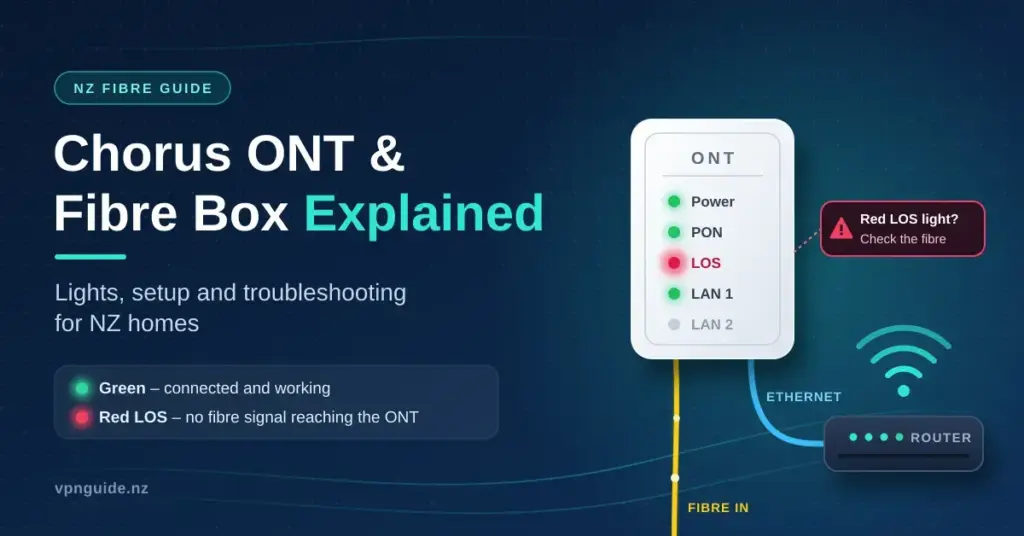
In New Zealand the box on the wall that brings the internet into your home is usually two devices doing two very different jobs: the Chorus ONT (Optical Network Terminal, the white fibre unit owned by the network company) and the Wi-Fi modem or router your provider supplies. This guide explains what each one does, how to connect them on fibre and wireless broadband, what every light on the Chorus ONT means, and how to fix the common faults — from a red LOS light to Wi-Fi dead zones. Chorus reported 1.147 million fibre connections at 30 June 2026 (about 75.9% of premises that can get fibre now take it), so for roughly three-quarters of Kiwi homes this hardware sits behind everything online.
The two halves of your fibre connection
For most people on a Fibre (UFB) plan, the setup is really a two-box system. The first box, the Optical Network Terminal (ONT), is the official hand-off point where the Chorus or local fibre network enters your home. The second box, the Wi-Fi router, plugs into the ONT and shares that connection with your phones, laptops and smart TVs. They can look almost identical, but they do opposite jobs: the ONT converts pulses of light from the fibre-optic cable into an electrical signal, while the router runs your local network and broadcasts Wi-Fi. If that split is new to you, our plain-English explainer on the difference between a modem and a router breaks it down further.
Quick Facts
| What it is | Two devices: a fibre ONT plus a Wi-Fi router |
| ONT owner | Network wholesaler (Chorus, Enable, Tuatahi, Northpower) |
| Router owner | You or your ISP (Spark, One NZ, 2degrees) |
| How they connect | Ethernet cable (Cat 5e/6) from ONT port GE1/LAN1 to the router’s WAN port |
| Common NZ ONTs | ONT 500 (newer), ONT 100/200 (older), Hyperfibre ONT Type 110 |
| Fibre uptake | About 75.9% of serviceable premises; 1.147 million Chorus fibre connections at 30 June 2026 |
| Fastest tier | Hyperfibre 2000–8000 Mbps (needs a Hyperfibre ONT and a 2.5/10 Gbps router) |
- The ONT (fibre box): owned by the network wholesaler (Chorus, Enable, Tuatahi First Fibre, Northpower Fibre). It stays with the property if you move.
- The router (Wi-Fi box): supplied by your ISP (Spark, One NZ, 2degrees and others) or bought by you.
- The link: the two boxes join with an Ethernet cable (Cat 5e or better) running from the ONT to the router’s WAN port.
- Placement: both need mains power, and the router works best somewhere central and open rather than in a cupboard.
ONT vs router at a glance
| Feature | Optical Network Terminal (ONT) | Wi-Fi router / modem |
|---|---|---|
| Owner | Network wholesaler (Chorus, Enable) | You or your ISP (Spark, One NZ) |
| Main job | Converts light to electrical data | Shares the connection over Wi-Fi and cable |
| Connects to | The external fibre line on the wall | The ONT, via an Ethernet cable |
| Has Wi-Fi? | No (standard models) | Yes — this is its main purpose |
| Goes with you when you move? | No — stays with the house | Yes (if you own it) |
Setting up the connection for the first time
A standard fibre install is mostly about connecting things in the right order. First, make sure the ONT is powered on and showing a solid green PON (or Optical) light, which means it has a healthy link back to the street. Then run an Ethernet cable from the ONT’s active port (usually GE1 or LAN1) to the router’s WAN port — often coloured blue or labelled ‘Internet’. Once the router boots, its ‘Internet’ light should come on, signalling that your home network is live and ready for devices.
Step-by-step fibre setup
- Power on the ONT: plug it into the wall and check the POWER and PON lights are solid green.
- Cable it up: use a Cat 5e/6 Ethernet cable from the ONT’s GE1/LAN1 port to the router’s WAN port.
- Power on the router: switch it on and wait two to five minutes while it initialises and finds the signal.
- Connect your devices: use the Wi-Fi name (SSID) and password printed on the underside of the router.
Reading the lights on your Chorus ONT
When the internet drops, the lights on the ONT are the first clue. A red LOS (Loss of Signal) light is the serious one — it means little or no light is arriving through the fibre. If the ONT lights are all healthy but the router shows a red ‘Internet’ or ‘WAN’ light instead, the fault is usually a login or configuration issue with your ISP or a bad Ethernet cable. Reading the lights before you call support saves time, because you can describe the exact status — and it tells you whether a line test is even needed. Chorus publishes plain-language light guides on its ONT fibre box support pages, including a dedicated ONT 500 guide. The checker below covers the newer ONT 500 (POWER, PON, LOS, GE ports) and the older ONT 100 and 200 (POWER, OPTICAL, ALARM, LAN).
ONT Light Checker
| Light | Status | What it means and what to do |
|---|---|---|
| POWER | Solid green | The ONT has mains power. If it is off, check the plug and the wall switch. |
| PON / OPTICAL | Solid green | Healthy link to the network. Flashing green means it is still trying to connect — wait a few minutes. |
| LOS | Red (solid or flashing) | Solid: no fibre signal. Flashing: weak signal. Check the fibre lead and the Chorus outage map, then log a fault with your provider. |
| GE / LAN | Green or flashing green | Data is flowing between the ONT and your router. Off means the Ethernet cable is loose or in the wrong port. |
| Internet (on router) | Red or off | The router isn’t logged in to your ISP. Restart it, check the cable, and confirm your connection settings. |
Fixing a red LOS light
A solid red LOS light means no light is reaching the ONT; a flashing red LOS means the signal is weak. Work through it in order: check the thin fibre lead for kinks or a loose connector at the wall, then check whether it is a wider fault on the Chorus internet outages map. If the lead looks fine and there is no known outage, log a fault with your provider. Restarting the ONT rarely clears a genuine signal fault, because the problem is on the physical line rather than in the box.
Fixing frequent drops and lag
If the connection is up but keeps stuttering, the cause is often local interference rather than a network fault. Our guide to why your internet keeps dropping out works through the causes in order, but start with these:
- Power cycle both boxes: unplug the ONT and router for 30 seconds, then power the ONT up first.
- Check the ports: make sure the Ethernet cable is firmly clicked into the correct GE1/WAN ports.
- Let it breathe: give the router space and airflow — an overheating router can freeze and reboot.
- Check the cable: a slow link with a healthy LAN light can point to an old or damaged Ethernet cable.
ISP hardware: Spark, One NZ and 2degrees
Each major NZ provider ships its own router, usually tuned to a particular Wi-Fi standard — Wi-Fi 6 or the newer Wi-Fi 7. Spark’s Smart Modem 3 and Futura are Wi-Fi 6 units (the Futura adds a mobile backup link), while the Nokia FastMile 5G Gateway 7 is a Wi-Fi 7 device used on Spark’s 5G wireless plans. One NZ supplies the TP-Link Deco BE28, a Wi-Fi 7 mesh router for fibre. If you would rather buy your own hardware, you will need to match a few New Zealand-specific settings, covered below.
Popular ISP routers compared
| Router | Provider | Wi-Fi standard | Notable feature |
|---|---|---|---|
| Smart Modem 3 | Spark | Wi-Fi 6 | Pairs with Smart Mesh 2 units for larger homes |
| Futura | Spark | Wi-Fi 6 | Built-in mobile backup if the fibre drops |
| Nokia FastMile 5G Gateway 7 | Spark (5G wireless) | Wi-Fi 7 | All-in-one 5G modem and router |
| TP-Link Deco BE28 | One NZ | Wi-Fi 7 | Mesh-ready with 2.5 Gbps ports |
| Nokia / mesh kit | 2degrees | Wi-Fi 6 | Easy mesh expansion for bigger homes |
For a wider look at what to buy, see our guide to modems in NZ and our guide to home Wi-Fi routers.
Setting up a BYO modem or router
Bringing your own device gives you more control but means configuring a few settings by hand. Values vary slightly between providers, so confirm them with your ISP before you start:
| Setting | Typical NZ value |
|---|---|
| Connection type | DHCP (automatic) or PPPoE |
| VLAN ID | Often 10 for fibre (check with your provider) |
| MTU | 1500 (DHCP) or 1492 (PPPoE) |
| Authentication | Username and password (only if PPPoE) |
Placing your router for the best Wi-Fi
Where you put the router is the single biggest factor in home Wi-Fi quality. Wi-Fi signal spreads outward and slightly downward, so a router sitting high on a shelf in a central room — the lounge, say — covers far more of the house than one hidden in a garage or a metal wiring cupboard. Common Kiwi building materials such as brick, concrete block and large mirrors reflect or absorb the signal before it reaches the far rooms. In a large or two-storey home, one router often is not enough, which is where a mesh system comes in.
Placement best practice
- Central: keep the router near the middle of the house to shorten the distance to every room.
- Elevated: a shelf or table beats the floor for coverage.
- Open: avoid cupboards, and don’t tuck it behind a TV or a fish tank.
- Away from interference: keep it clear of microwaves and cordless phones that share the 2.4 GHz band.
Fixing Wi-Fi dead zones
If the signal can’t reach the back bedroom, a few approaches help. Our Wi-Fi extender guide and dedicated mesh Wi-Fi guide compare them in detail:
| Solution | Best for | Typical result |
|---|---|---|
| Mesh Wi-Fi | Large or multi-storey homes | Seamless whole-house coverage |
| Wi-Fi 6 / 7 router | Homes with many devices | Better handling of crowded networks |
| Ethernet backhaul | Gaming and home offices | Rock-steady, low-latency link |
| Changing the Wi-Fi channel | Dense suburbs and apartments | Less interference from neighbours |
Wireless broadband: the all-in-one box
For homes that can’t get fibre or want a simpler setup, wireless broadband uses a single box that is both modem and router. It connects to nearby 4G or 5G mobile towers — just like a phone — and broadcasts Wi-Fi straight away, with no ONT and no wall-mounted fibre box. Installation is close to plug-and-play, but performance depends on how far you are from the cell tower and can dip at busy times. In the Commerce Commission’s Measuring Broadband New Zealand testing (April 2026, published July 2026), fibre remained clearly ahead: Fibre 500 averaged about 514 Mbps with the lowest latency of any technology, while only around 38% of Spark 5G Max Wireless tests topped 500 Mbps and roughly 41% of 4G fixed-wireless tests fell below 25 Mbps at peak. Our 5G internet NZ guide covers wireless plans in more depth.
Pros and cons of a plug-and-play box
- Pros: instant setup, portable (move it anywhere with power), no technician visit needed.
- Cons: higher and less predictable latency, speeds that fluctuate at peak, some sensitivity to weather.
- Best for: renters, small apartments, and areas where fibre is not yet available.
Securing your internet box
In 2026 the security of your router matters as much as its speed. Every router ships with a default Wi-Fi password and a separate admin password for its settings menu — change both straight after installation. Switch the encryption to WPA3 where your devices support it, since it is meaningfully stronger than the older WPA2 standard, and keep the firmware up to date so the latest security fixes are applied. New Zealand’s government-backed Own Your Online service has a clear guide to securing a home network.
Router security checklist
- Change the admin password: never leave it as ‘admin’ or ‘password’.
- Turn on WPA3: use the strongest encryption your devices can handle.
- Add a guest network: a separate Wi-Fi for visitors keeps them off your main devices and files.
- Automate firmware updates: set the router to check for and install updates on its own.
What’s next: Wi-Fi 7 and Hyperfibre
The next step up in New Zealand is Wi-Fi 7 paired with Hyperfibre. At 2, 4 and 8 Gbps, Hyperfibre needs a different Chorus unit — the Hyperfibre ONT (Type 110), which has a single auto-sensing 10 Gbps Ethernet port — plus a router with a 2.5 Gbps or 10 Gbps WAN port so the router doesn’t become the bottleneck. Chorus refreshed its wholesale fibre plans in 2025 to Home Fibre Starter, Home Fibre 100, Home Fibre 500 and Home Fibre 920, alongside Home Hyperfibre 2000, 4000 and 8000; retail plans are usually sold as Fibre 100, Fibre 500 and Fibre Max. Wi-Fi 7 hardware, now rolling out through providers such as Spark and One NZ, improves latency and can handle 100-plus devices at once. If you want to know what those plans really deliver, see our guide to fibre speeds in NZ.
| Connection | Typical speed | Hardware you need |
|---|---|---|
| Fibre 100 / Fibre 500 | 100 or 500 Mbps | Standard ONT + Wi-Fi 6 router |
| Fibre Max | 900+ Mbps | Standard ONT + higher-end router |
| Hyperfibre | 2000–8000 Mbps | Hyperfibre ONT + 2.5/10 Gbps router |
| Wireless 5G | 100–500 Mbps | All-in-one 5G modem/router |
The bottom line
Knowing which box does what is the key to a smoother connection. Whether you are decoding a red LOS light on the ONT or moving the router to a better spot for bedroom Wi-Fi, understanding how the two devices work together helps you get the full value of your plan — and makes the call to support much shorter when something goes wrong. For wider background on how the network came to be, the Wikipedia overview of the internet is a starting point.
Sources
- Chorus: ONT fibre box support and light guides
- Chorus: ONT 500 guide
- Chorus: ONT Types 100 and 200
- Chorus: Hyperfibre ONT Type 110
- Chorus: internet outages map
- Chorus: FY26 connections and results (30 June 2026)
- Commerce Commission: Measuring Broadband New Zealand reports
- Spark: Nokia FastMile 5G Gateway 7 support
- One NZ: about the modems we supply (Deco BE28)
- Own Your Online: secure your home network
Frequently asked questions
What is the internet box on my wall called?
It is an Optical Network Terminal, usually called the Chorus ONT or fibre box. It converts the light signal from the street into an Ethernet connection, and a separate router turns that into Wi-Fi for your devices.
Why is the light on my Chorus ONT red?
A solid red LOS light means no light is arriving through the fibre; a flashing red LOS means the signal is weak. Check the fibre lead for kinks, check the Chorus outage map, then log a fault with your provider. Restarting the ONT rarely fixes a signal fault because the issue is on the physical line.
Can I move the fibre box to another room?
Not yourself. The ONT is fixed to the wall and spliced to the external fibre lead, so relocating it is a job for a Chorus or local fibre technician booked through your provider, and it may cost extra. Moving the router is the easy alternative: run a longer Ethernet cable from the ONT to a better spot.
Do I need a separate router for fibre?
Yes. A standard Chorus ONT has no Wi-Fi and only a few Ethernet ports, so you connect a router to its GE1 or LAN1 port to share the connection with your devices.
Can I take the ONT with me when I move house?
No. The ONT belongs to the network company and stays with the property; removing it delays the next occupant’s connection and can incur a charge. Your router is yours (or your provider’s) and goes with you.
How do I restart my internet box properly?
Unplug the power from both the ONT and the router for 30 seconds. Power the ONT on first and wait for the POWER and PON (or OPTICAL) lights to go solid green, then power on the router and give it a few minutes to reconnect.
Is wireless broadband better than fibre?
Fibre is faster and more stable: in the Commerce Commission’s April 2026 testing, Fibre 500 averaged about 514 Mbps with the lowest latency of any technology, well ahead of fixed wireless. Wireless boxes win on simplicity and portability, which makes them a good fit for renters and homes without fibre.


